
Spazio San Carlo and Lorenzo Spinelli: Art as Verification
Lorenzo Spinelli and Spazio San Carlo provide a paradigm for understanding the formative potential of artistic research.
Among the private Italian institutions capable of contributing to the international artistic debate — see our annotated list [link] — the case of Spazio San Carlo in Cremona is perhaps the most complex and fascinating. This is not merely due to its location within a deconsecrated church, the Church of San Carlo, whose history feels almost scripted for a modern rebirth that respects its original function. Nor is it simply because it sits in a city that, despite its immense contributions to other fields, had lacked a prominent voice in contemporary visual culture for centuries. Rather, the San Carlo case is unique because of its founder, Lorenzo Spinelli, a “meta-artistic” personality who evokes the multifaceted genius loci of Antonio Campi. A key figure of the most important family of painters in late 16th-century Lombardy, Campi was also a fabric merchant, real estate developer, architect, and historian.
Just as Antonio Campi and his brothers established a workshop capable of managing complex commissions for an exacting elite — much like the great Renaissance botteghe (one might recall the exhibition on Verrocchio’s workshop at Palazzo Strozzi) — Spinelli has developed a sort of “mega-factory” called Form. The Creative Group. Form is a leader in the field of ephemeral architecture, designing trade fair stands, retail spaces, offices, restaurants, museums, pavilions, and installations of every conceivable scale and complexity.
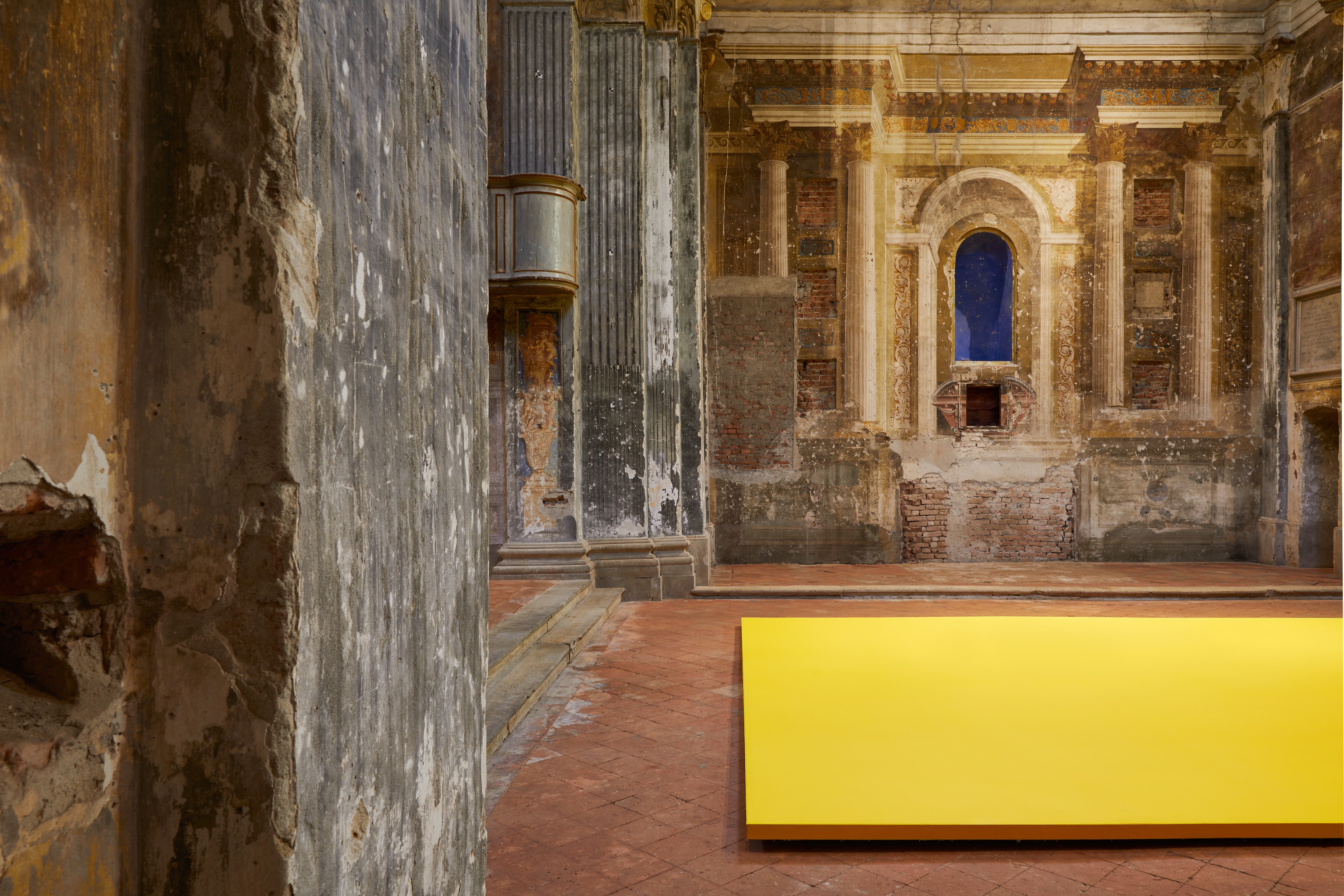
To grasp the uniqueness of Spazio San Carlo and the thirteen projects promoted to date — consistently in collaboration with galleries — Apalazzo above all, but also Franco Noero, Raffaella Cortese, Massimo De Carlo, Mendes Wood, Sylvia Kouvali, among others — one must first understand the work Form has been doing since 2008. Ephemeral architecture demands advanced expertise in interior design, photography, video, lighting, digital systems, graphics, and publishing.
What is crucial to highlight, and perhaps less obvious to outsiders, is that on both a creative and structural level, Spinelli has built a production engine capable of translating his own intuitions into form and substance. This “factory” operates according to a long-defined poetics steeped in minimalism, monumentality, and technological precision, all grounded in experience. The choice of artists and the projects commissioned for Spazio San Carlo must be viewed within this framework. San Carlo acts as an “activator” within a broader trajectory that intertwines temporary architecture with research, production, and thought. “San Carlo,” says the founder, “is not a detour, but a verification.” At its core lies a design and production structure capable of turning complex ideas into a concrete presence. Then there is the “direction” (regia), a poetic lens that acts before and after the work, making its existence possible through the factory’s “production superpowers.” As Spinelli puts it: “Professional practice deals daily with real constraints. San Carlo is born where these constraints loosen. Not as a diversion, but as a natural extension.”
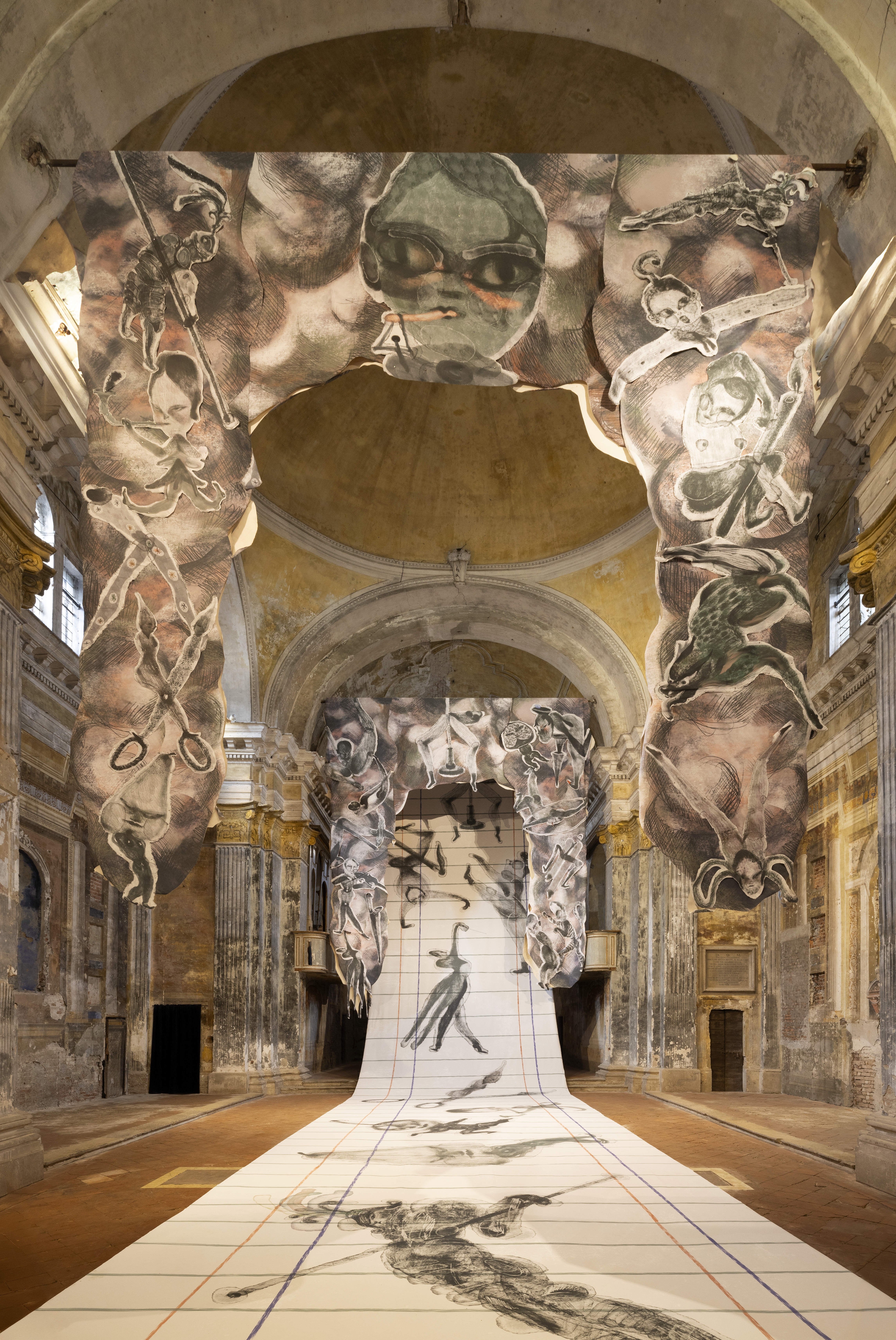
The fourteenth project at San Carlo, Sospeso nel moto con addebito di vuoto (“Suspended in motion with a charge of vacuum”), is paradigmatic in this sense. For this occasion, Guglielmo Castelli, an artist of extraordinary formal sensitivity, collaborates with Fabio Cherstich, an opera director who occasionally lends his vision to the worlds of visual arts, design, and fashion. Castelli’s vocabulary of pictorial images — a limbic constellation populated by elusive symbols — inhabits the canvas through a refined printing process. The result is a 65-meter-long, 5-meter-wide scroll unfurled through the nave and presbytery like a gargantuan, fluttering cartouche. On the ground, the red and blue borders of the fabric recall the pages of a school notebook. A massive, childlike face facing the counter-façade stands as the protagonist, while characters and objects painted as silhouettes (then printed) form its imaginary world. During the opening, musicians filled the space with strings and solemn voices, appearing as if they had stepped out of the canvas, or were ready to re-enter it. The prevailing sensation is that of being inside something contained by something else—a sort of conceptual theater or place of worship. Here, the patron is not at the center of the discourse but within the structure that makes it possible. Not in the creative formulation of the project — which belongs to the artists — but in the a priori gesture that constitutes its premise and the production capacity that allows the installation to take shape.
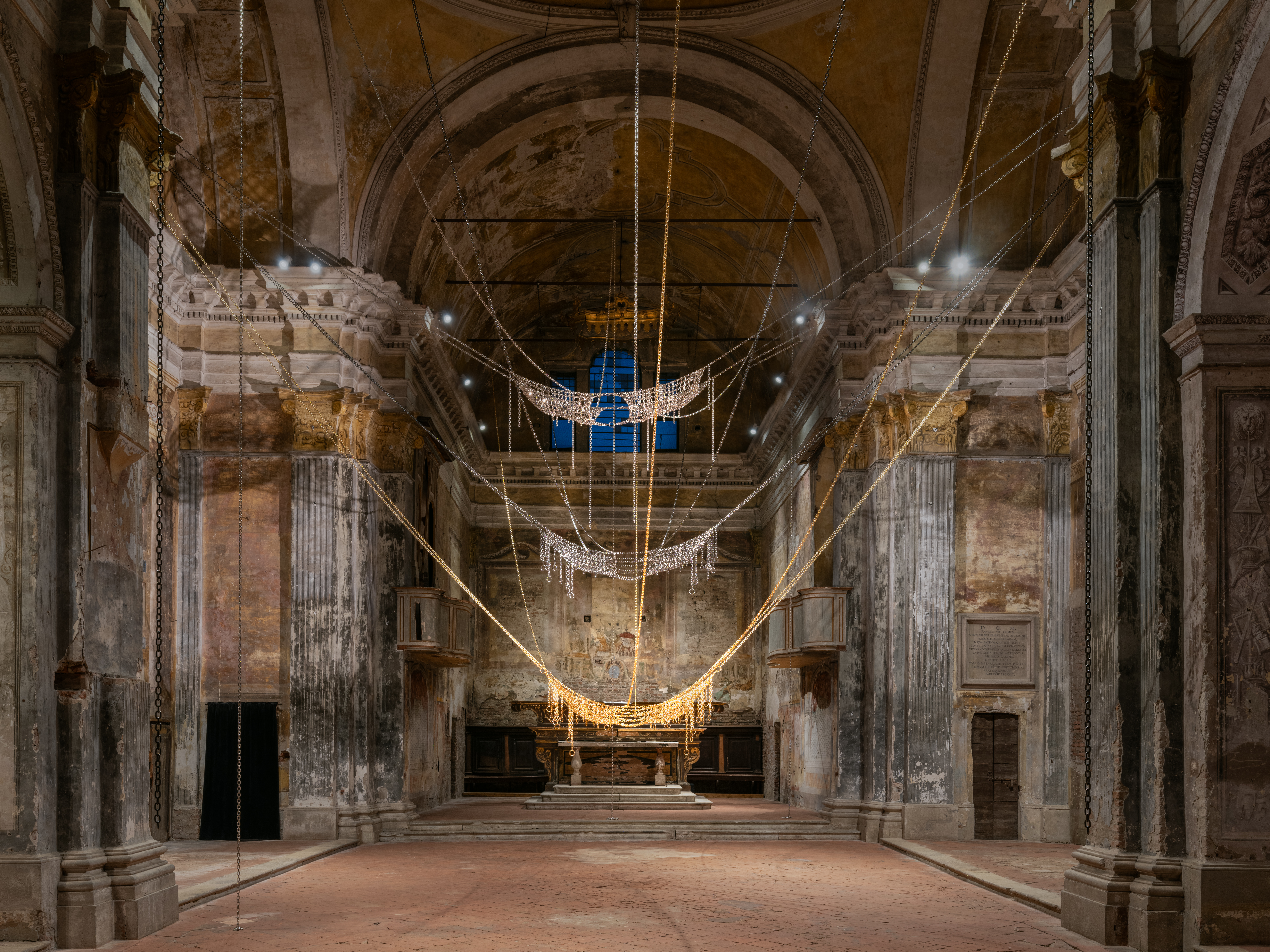
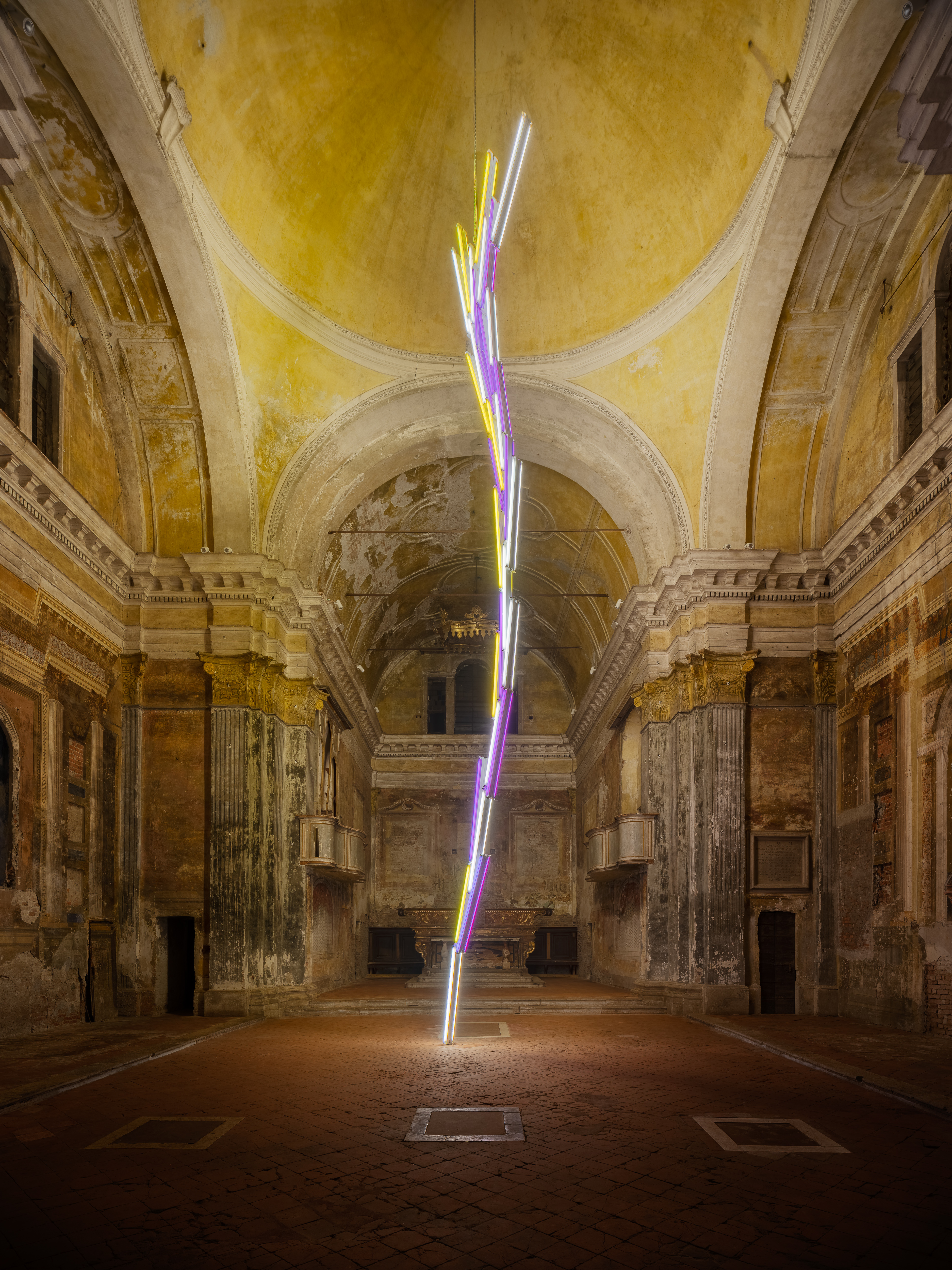
This a priori creative gesture and production prowess previously brought Mark Handforth’s neon lightning bolt to strike the center of the transept (White-Light-Whirlwind, 2022); it allowed Monica Bonvicini’s chains to delicately hint at the dualism of freedom and eroticism (And Rose, 2025). It enabled the yellow river imagined by Olivier Mosset to flow through the nave (San Carlo PG, 2023), the wreckage of Arthur Simms to inhabit the niches and chapels, and Jonas Mekas to project his deeply personal visual commentary on Giuseppe Verdi’s Messa da Requiem (Requiem, 2024). This confirms that Spazio San Carlo is profoundly different from a traditional museum or the noble spaces opened by contemporary collectors to share their holdings or celebrate specific artists.
Ultimately, these installations align with a personal poetics. This is reaffirmed in Essence of Form, a book published by Spinelli in 2025. The volume serves as a manifesto of method, told through 18 short texts, each dedicated to a key concept representing a year of Form’s existence from 2008 to 2025. Significantly, the text is illustrated with images of the installations produced for San Carlo, as if they were the visual component of the discourse developed in the writing — a relationship of mutual exchange and growth. There it is: Art as a formative practice exercised through human relations. Indeed, the author writes: “Some spaces last for centuries and are forgotten. Others exist for an instant and remain in memory forever.” It is within this tension between duration and perception that the trajectory of the entire project is measured. In the end, it is not about constructing forms, but about generating experiences that endure.
March 30, 2026

