
Andrea Romano’ see-through doors at Gaudel de Stampa: “pure and autobiographical”
-
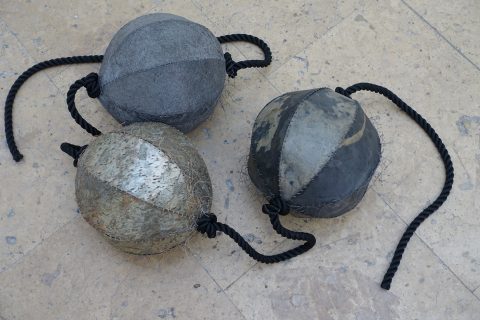
- Andrea Romano, Cocoons (Highlight 2015), 2015. Slate, fibreglass, rope.
-
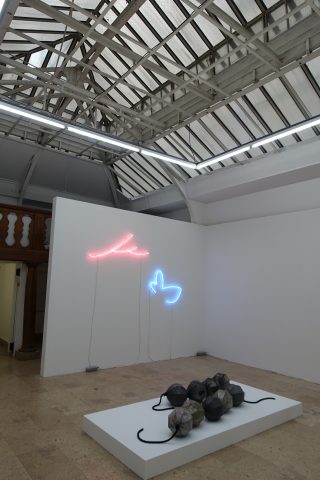
- Andrea Romano, Doorkijkje, installation view at Gaudel de Stampa.
-
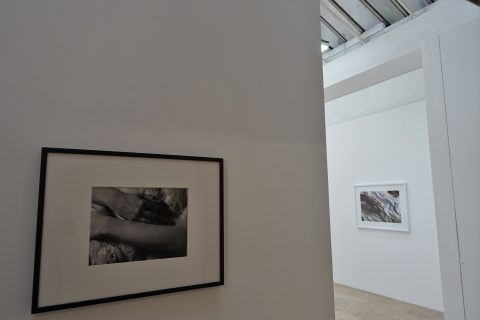
- Andrea Romano, Doorkijkje, installation view at Gaudel de Stampa.
Thin sheets of grey slate hand-sewn to generate mysterious cocoons. Neon lights wall drawings magnifying details from “The Flintstones”, the evergreen cartoon by William Hanna and Joseph Barbera. Close-up photographs of human hands manipulating the same pillow made of foam. These are the three simple units presented last week by Andrea Romano in his second solo exhibition at Galerie Gaudel de Stampa in Paris. The Dutch word “Doorkijkje”, chosen as a title for the show, refers to an extremely effective manner whereby 17th-century Dutch painters could achieve pictorial depth within domestic settings. And the kind of see-through doors Romano is talking about will likely become clearer after reading his answers to our Proustian inspired questionnaire.
What is your favourite subject matter?
I would say landscapes, which I tend to consider as an overall representation of reality.
Do you believe in abstraction?
It is a side of the human nature, as figuration itself is. My art practice involves a tension between these two elements. Or, at least, a relationship between them. Hence, yes, I do believe in abstraction.
Which is the most inspiring place for you?
I am inspired by those places in which different elements and feelings coexist. As, for instance, power and vulnerability, attention and abandonment. These elements are typical of the places I pass by every day. While going from the city centre to suburbs I see how people, architecture, shops, green areas change; from extreme care to disrepair, and vice versa. This variability affects my visual thinking.
Which is the quality that you prefer in an art dealer?
Complicity.
Which one in an art collector?
I love when they prove to be sharp and rigorous.
Who is your favourite artist?
In general I like artworks that I can’t fully understand, or that have blind spots. And I like artists whose work is pure and autobiographical enough for mirroring what is collective and absolute. While in regards with traditional art I am fascinated by Flemish artists of the 17th century. What interests me is their awareness of the moral role played by painting at their time.
Is there any colour or shape that you really hate?
I don’t have any taboo.
What makes an idea become an artwork?
I think that art comes from ideas, and generates ideas at the same time. But I also think that artworks are already born as images and shapes in the mind of the artist. Then it is his work that makes them real.
Which novel could better represent your idea of art?
The novels I’ve read, as every experience of the human being that I know, generate many visual memories in me. I can’t have a single reference.
What would you have done if you hadn’t been an artist?
I would be an architect.
November 11, 2015

