
Marina Rheingantz (an interview)
First interview with Marina Rheingantz after she has become a mother sheds more lights on relationship between life and art.
As is the case for many artists, parenthood has represented for Marina Rheingantz a pivotal moment of reflection on her artistic practice and on the very conditions of creativity. For a studio-based painter such as Rheingantz, this shift acquires particular relevance, reaffirming the transformative force that maternal experience can exert on artistic production. Encountering her work on the occasion of her first major exhibition following the birth of her daughter Manuela therefore offers a privileged perspective from which to investigate the profound and inseparable relationship between life and artistic practice.
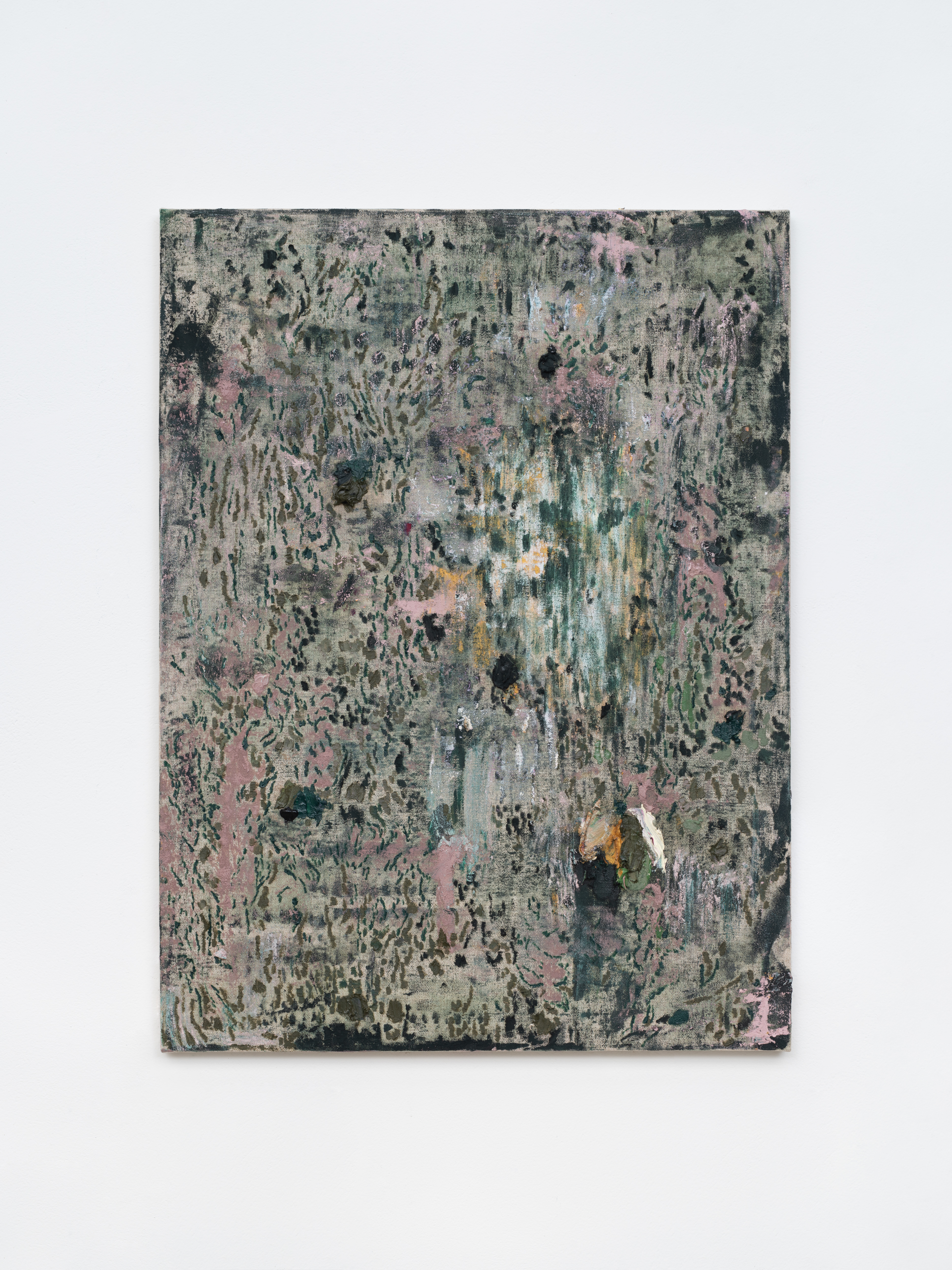
Rodamoinho (Whirlpool in Portuguese) currently on view at ICA Milano, is your second institutional exhibition in Europe this year – after Mirage, at Nîmes’ Musée des Beaux-Arts, that ran between April and October 2025 – but the first to be produced entirely after you gave birth. Has the experience of becoming a parent impacted your art production?
Marina Rheingantz: Yes, it definitely had an impact. Now I have much less time in the studio. Before, I would spend around 8 to 10 hours a day in there, and I did other things too: read, cooked, tended the garden, looked at my art books. After Manuela was born, I started spending only half of the day there. At first, I took her with me and worked between feedings. After she started on solids, I began going alone, part-time. I think my focus changed as well. Since time has decreased considerably, now I arrive at the studio and try to make the most of it. I haven’t been able to resume the watercolours yet, for instance.
Further, it also impacted my poetics. Before she was born, I made three paintings that I named after the names I wanted to give my daughter: Lola, Agnez, and Manuela. There’s another painting at the ICA called Tetê, which looks like a waterfall of milk. There’s yet another one called Ultrasound, as it resembles an ultrasound image. Then there is yet another painting I did even before she was born, called Bellybutton. But all of this appeared abstractly in the work, and the names came later. Nothing was planned ahead, it was all kind of natural and intuitive. The paintings always have something to do with what I’m going through in my life.

The exhibition at the ICA features a large tapestry, which, if I’m not mistaken, is a detail from one of the paintings on display. Most of your recent exhibitions feature a textile element, tapestries and also embroidery. What is the relationship between this body of textile work and the paintings?
Marina Rheingantz: The ICA tapestry was made from a slightly older painting, which isn’t on show. The original composition is vertical, which I edited to become a horizontal tapestry, plus we made it much larger.
This relationship began around 2015. I’ve always been interested in fabrics, but in 2015 in London, I started researching tapestries. Then references to tapestries began to enter my paintings; for instance, the short brushstrokes, as if they were the weaves of a tapestry. At the beginning the main reference was Moroccan tapestries, which I really like for their nod to landscape, but a landscape embedded in symbols, more abstract. At first this influence was channeled in small paintings, and in parallel I did the landscapes. Over time I started to mix the landscapes with the texture of fabrics. A few years later I started doing embroidery and tapestries; it all happened quite naturally. Now in Milan we did a Jacquard for the first time, where I combined the texture with the paintings.
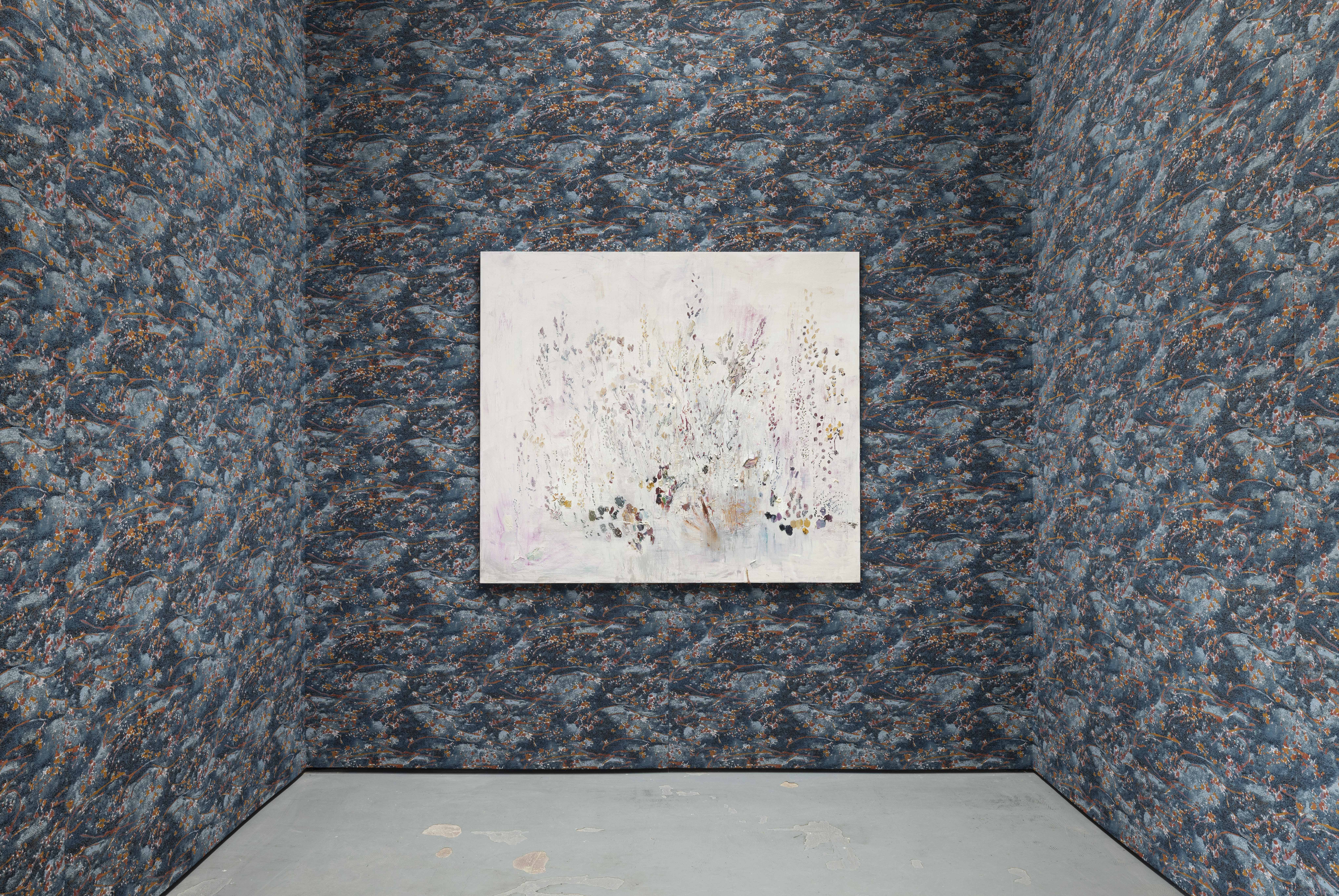
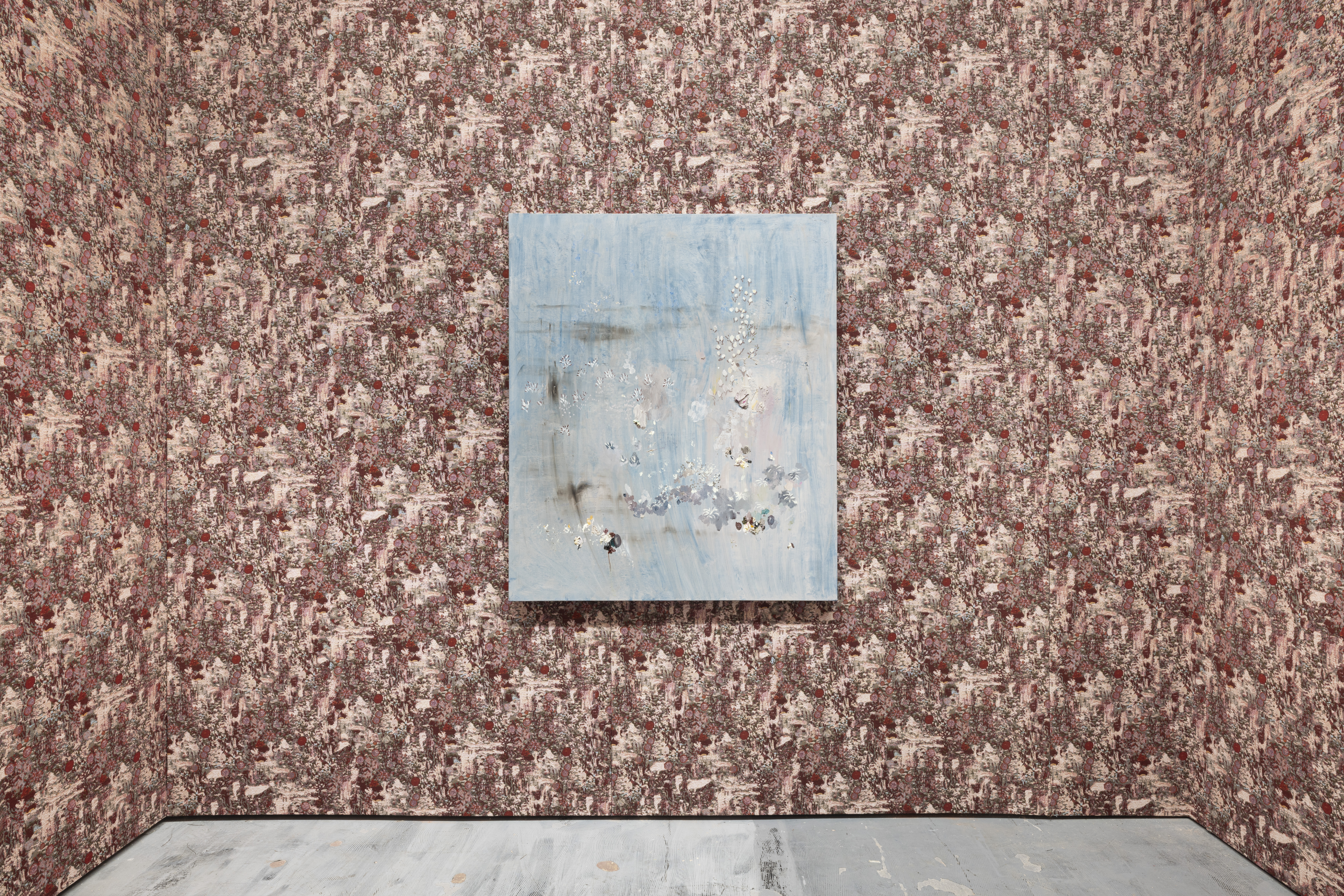
It’s interesting that the Jacquard acts as a kind of wallpaper, offering both a context and a new layer of interpretation for the works. Is this a path you want to explore further: creating contexts, or ways of showing your paintings that flirt with the idea of an installation? Do you see yourself adding a sculptural dimension to your works?
Marina Rheingantz: I guess so, I’d like to experiment with other mediums. And yes, I also enjoyed showing the paintings in a different context, with the Jacquard. I think it’s a start, but I’m still figuring out how to develop it further. I really want to make ceramic sculptures at some point.
Do you imagine these ceramic sculptures emerging from your painting, like the fabrics, or something completely autonomous, like something else entirely?
Marina Rheingantz: That’s a good question, I haven’t the slightest idea. I’d have to start to understand how it would evolve.
Returning to the maternal dynamic: one of the ways in which fabric manifests itself in your work is through embroidery, which is done in partnership with your mother. Can you tell us a little more about these works?
Marina Rheingantz: The embroidery came about quite naturally. I was creating paintings that used fabrics and tapestries as references. One day my mother saw a small painting in the studio and thought it would look nice as an embroidery. That’s how we started. The embroideries are always based on a small fragment of a painting, or a watercolour.
Do you paint from memory, photographs, dreams, your daily life, or a mixture of everything?
Marina Rheingantz: I’d say a mix of everything, several paths intersecting. Lately, many paintings are without a specific reference point, but rather a process about painting itself. The process of creating.
I’m always struck by works with a composite date range – for example, 2012–15. This interval could be for various reasons, but I usually imagine the artist stuck on a piece, in a process of doing and redoing until reaching a result that can be called finished. Have you experienced situations like this, where you needed to distance yourself to know how to continue? Do you have any formula or ritual for resolving creative knots?
Marina Rheingantz: Yes, many times paintings get stuck, and then I leave them for a few months, sometimes years, and come back to them later. I have some rituals: I look at books, read poems, look at my personal image archive, make drawings and watercolours.
And sometimes, in spite of the rituals, I still get stuck for years. Sometimes a new painting helps to resolve another very old one as well…
January 15, 2026

