
Focus on Qatar: an interview with Emin Balcıoglu
Conceptual Fine Arts sat down with the meta-curator who is behind Doha’s museums blossoming and cultural strategy.
-
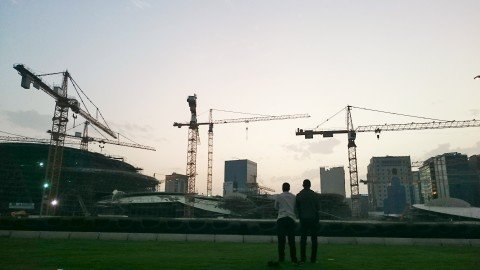
- The National Museum of Qatar, opening in 2016.
-
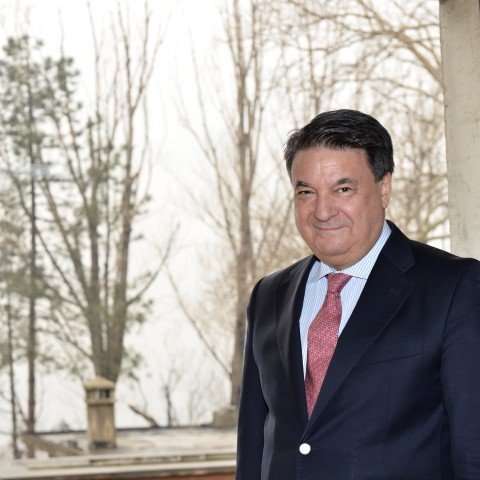
- Emin Mahir Balcıoglu.
Emin Mahir Balcıoglu is an independent meta-curator, that is to say someone whose job doesn’t consist in creating exhibitions – as a curator generally does – but in setting up museums and cultural institutions. Since 2011 he has been working mainly in Doha and developing the National Museum of Qatar and the Orientalist Museum. Turkish-born, he has lived many years abroad, 12 of which spent in Italy. With a degree in architecture, he began his career by working with the Aga Khan on cultural projects in the Third World. Then he went back to Istanbul, where he started his unique occupation. He visited the first museum when he was six years old thanks to his father, the Turkish consul general in Naples during the Fifties.
When did you start to work for the Qatar Museum Authority?
I’ve started to work with QMA in January 2011, and I’ve finished my task at the beginning of this year, when I’ve started to deal with a new project in the Msheireb, who is planning to open three little museums in the next few months, possibly already in April. One of them will be dedicated to slavery.
Could you tell us more in this regard?
Msheireb is a project of urban renovation, focused on a 750000m2 urban space in Doha city-centre, which will be completely rethought and reconstructed. It is indeed a prime example, which shows how this city’s architectural works – and not only – should be conceived. That is to say, unlike many of the buildings recently constructed, that don’t meet either the cultural expectations, or the social ones, or even the environmental issues of this city for that matter.
Are you thinking of the skyscrapers?
Exactly so. They do fit neither with the weather, nor with the local culture. Hence, we have been thinking about a different kind of architecture, on a more human scale. We have been trying to value more a pedestrian lifestyle, rather than promoting the use of cars – which as a matter of fact will end up in underground parking garages. This new settlement will take into account the real needs.
One of this needs is indeed culture, isn’t it?
It is indeed. That is why i also thought of including the museums i was telling you about before.
How would the National Qatar Museum designed by Jean Nouvel fit in this context?
The plan is coming along, yet it is rather complex. Hence it is proceeding slower than expected. The opening should take place in 2016.
Are there financial issues involved?
I wouldn’t say so. The delay is due to other factors.
Have you also been involved with the development of the National Museum?
Yes, i have but only for eight months, after the resignation of the previous director. At the same time, always for the QMA, I was dealing with the Orientalist Museum, designed by Herzog & De Meuron. Working on two projects of that sort has been very challenging.
What are then the issues that are delaying the opening of the National Museum?
First of all, the architecture. I’m sure that once the museum is completed, everything will work properly, and Doha will become a landmark in the international cultural scene – from Nouvel’s structure, inspired to the desert sand rose, everyone is expecting a “Bilbao” effect. Yet, the path to get to this point is all but uphill. To start with, there won’t be any straight wall in the museum. Besides, the museum will exhibit information, more than objects and a substantial multimedia equipment is thus expected. Could you imagine projecting a video on a curved wall?
Information, instead of objects?
Yes, exactly. For instance, the history of Qatar won’t be told through written words, or objects, but through interviews to people who have related the major transformation that Qatar has been undergoing in the last years, according to their own personal memories. This is also how the visitor will go through a journey from a nomadic society of pearl hunting, often poor, to a society which, from gas and oil, is trying to make information and culture its very core. For a citizen of Qatar, this museum will certainly become a source of pride.
This history is the same one that today is related by the extraordinary Sheikh Faisal Museum.
Right.
And is it here where the remarkable purchases by Qatar on the art market, like Cézanne’s Card Players, or the painting by Gauging recently sold on auction for $300 million will end up?
No, it isn’t. These artworks will be shown in other museums, like that of Orientalist art, for instance, which won’t only be a museum, but also a research center, to better understand the problem of Orientalism and how Orient and Occident have been reciprocally perceived over the centuries.
A fundamental topic nowadays.
Certainly if we consider that the aim of this comparison is to ultimately find the common denominators shared by both cultures.
So let’s clarify this latter point. These noteworthy purchases are carried out following specific cultural demands, and aren’t simply trophies to show off or demonstrations of economic power.
Exactly. In the Orietalist Museum, for example, Jean-Léon Gérôme and Eugène Delacroix will be exhibited.
And Gaugin’s?
I don’t know.
Whoever is actually comparing today’s Qatar to Lorenzo de Medici’s Florencce, or Francis I’s France, doesn’t seem to be mistaking them.
No, it doesn’t. As I was saying, the choices made in the past few years have been following precise plans. Qatar is a very wealthy country today, but it is aware that these wealth alone are not enough to build its own national identity. I wish that the country will keep on following this strategy in the years to come. To think of Qatar as a center of culture, information and education is the best approach to it.
It is said that in Qatar there is the most important us military base of the Middle East. To what extent do you think US has contributed in shaping today’s country’s attitude?
As a matter of fact, little is known with regards to this military base. In four years I haven’t seen even one American soldier around. Having said so, I don’t believe that US have in any way influenced the choices that have been made, at first, by Sheikh Hamad bin Khalifa Al Thani, the father of the current Emir of Qatar, and by his mother Sheikah Mozah. On the contrary, we could argue that it is she the brain behind such extraordinary cultural flourishing, which doesn’t only concern museums and music – it is thanks to her, for example, that the Qatar Philharmonic Orchestra has been founded in 2007– but also universities, research centers and education. These choices can indeed be regarded as revolutionary for this society.
What is the role played by Mayassa Al Thani, one of the leading figures in the International contemporary art scene?
She is still a very influential leader in the QMA. She is young, and is managing very well a situation, which as anyone can easily predict, is as extraordinary as complex. However, if it was only for her, there would be even more museums.
A last question, related to your Turkish origins. Which was born first, the Museum of Innocence by Orhan Pamuk, or that of the Sheikh Faisal.
This latter, undoubtedly. Even if I don’t think that Pamuk has ever seen it.
December 15, 2017

