
Tom Hardwick-Allan: Scrying the Slice
In Tom Hardwick-Allan’s work, there is a playfulness almost without irony, a lightness that refuses to fix itself in position, a practice of instability and circulation.
Tom Hardwick-Allan moves between cast iron, carved wood, printmaking, poetry, zines and music. The work is not organised by medium so much as by a recurring condition: contact, and what persists after it. A surface meets another surface, something is transferred, and the encounter ends. What remains is never the object itself but a trace, partial, displaced, unstable, that registers relation rather than presence.
In ornithology, imprinting describes the moment a newly hatched bird fixes its sense of identity onto the first figure or object it encounters. It is irreversible contact, recognition produced through exposure. Hardwick-Allan extends this biological logic into a broader model of making. Printmaking becomes “a kind of social printmaking,” where information passes between surfaces and is altered in transmission. The imprint is never neutral: it is a deformation produced by encounter rather than a copy of an original.
The ghost in the iron
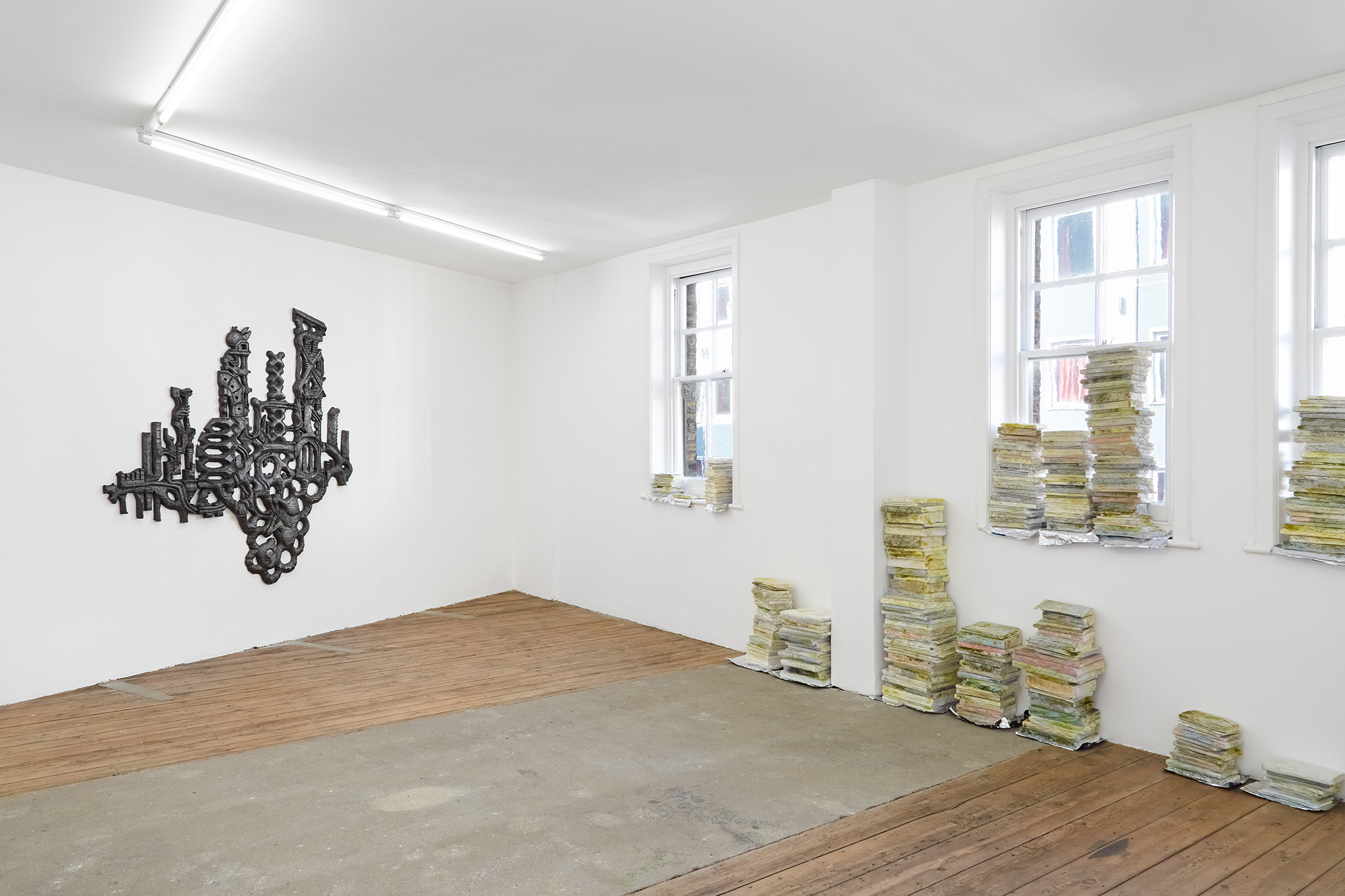
Tom Hardwick-Allan melts brake discs, the same material involved in a car accident affecting his father and grandmother, who survived but were “altered forever by this rupture that was both a failure to make contact and a violent amount of contact made.”
Iron operates here as both medium and index of obsolescence. For Harwick-Allan, iron is a very immune kind of material. Structurally weak yet persistent, it enabled the acceleration of agricultural and industrial systems before revealing its inability to sustain the regimes it helped produce. Left unsealed, it eats itself, oxidises and gradually disintegrates, returning to dust.
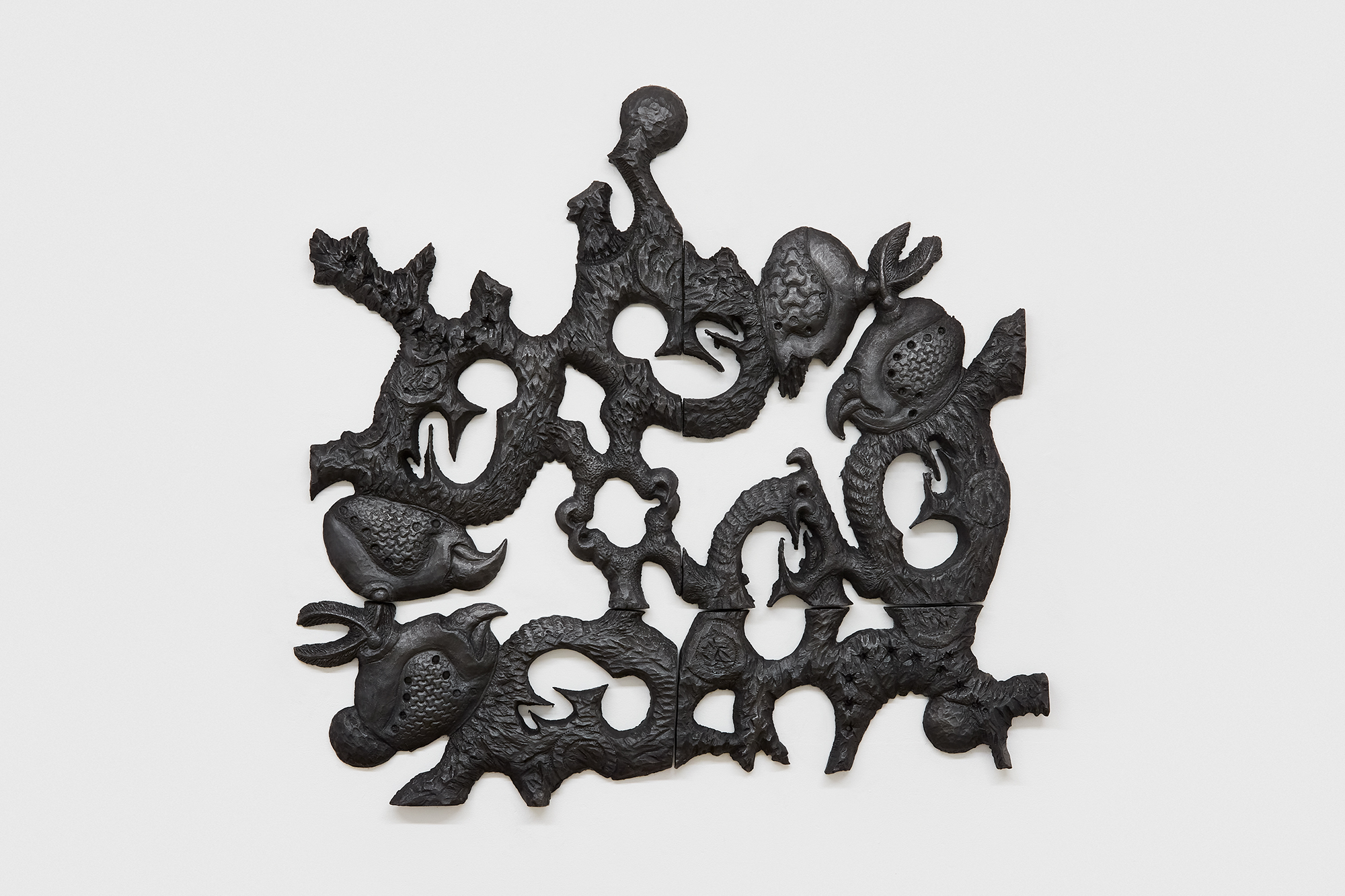
In Hardwick-Allan’s casting process, carved wood is pressed into sand mixed with oil, producing a negative form into which molten iron is poured, treated like black ink. The relief carries the grain of both wood and sand, though neither remains and the two have never touched. What remains is neither trace nor copy, but a compound structure in which pressure, grain, and disappearance are registered without their original supports. What is retained is not an object but the conditions of its passage: a configuration produced through disappearance rather than preservation.
Before the vanishing point
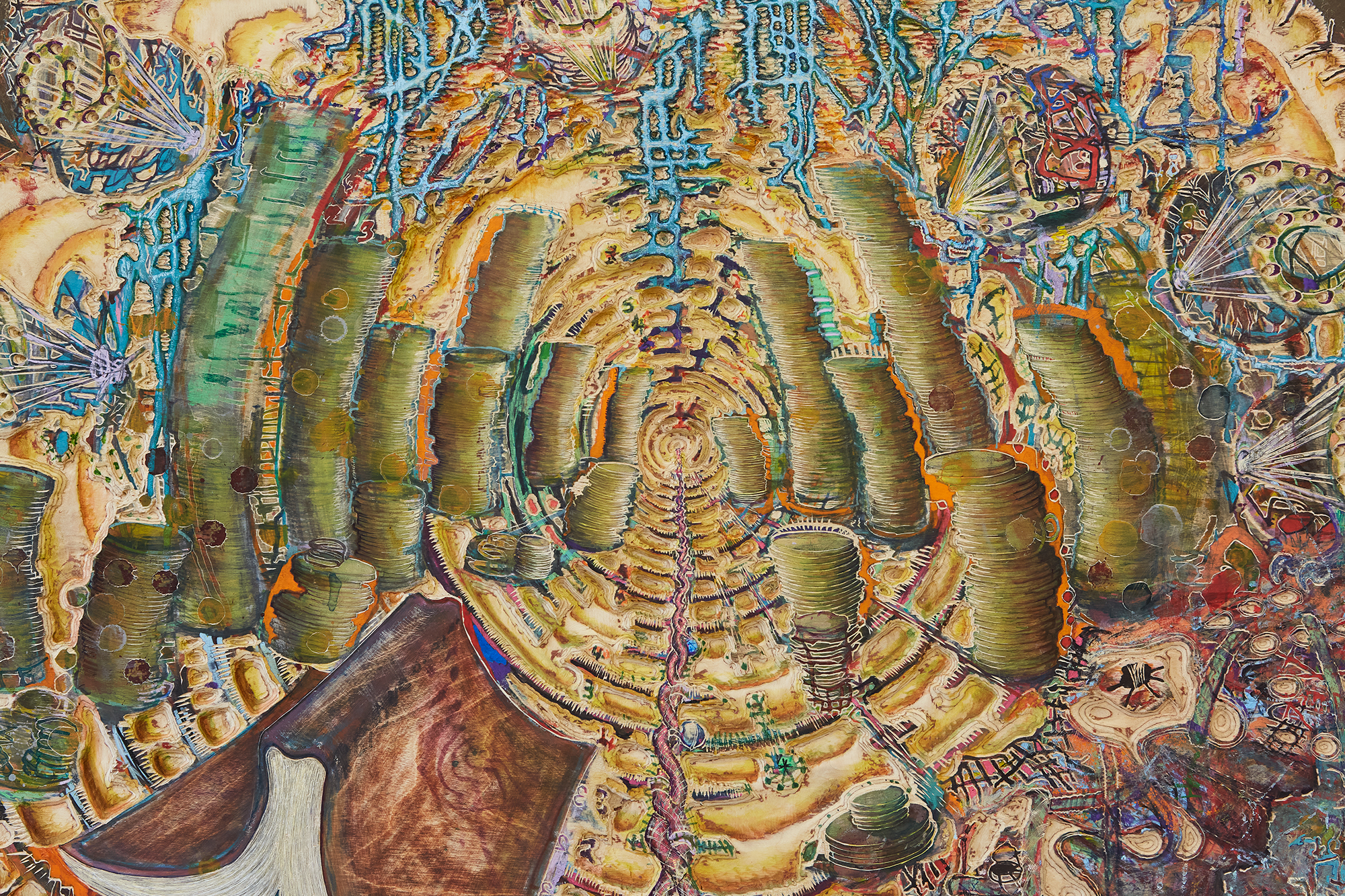
Hardwick-Allan’s work engages earlier regimes of representation in which vision is not organised around a single sovereign point of view. Against the model of linear perspective and its construction of depth, the work privileges surfaces, reversals, and compressions of space – forms in which meaning is not stabilised by a fixed gaze but continuously displaced through collision.
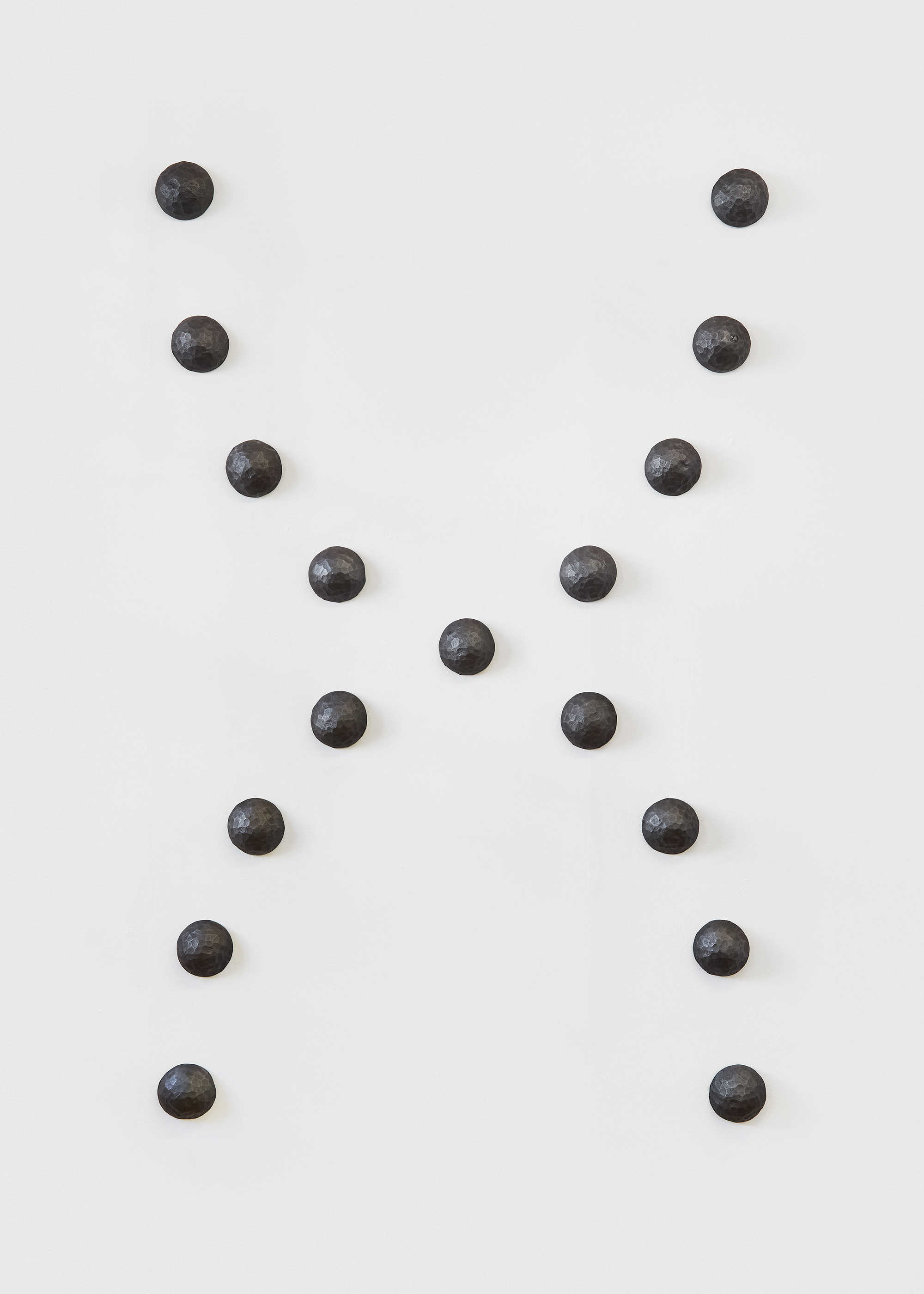
His work continuously returns to the vanishing-point perspective, the representational technique which emerged during the Renaissance presupposing a unified viewpoint from which space is ordered and depth made legible on a flat surface. It installs a single organising eye, replacing earlier systems in which relations of scale, position and meaning remained multiple and unstable. Hardwick-Allan’s low reliefs occupy an ambiguous relation to this history: they do not recede into depth but instead push outward toward the viewer, compressing spatial logic into the surface itself rather than opening it onto illusionistic space.
In J. A. Baker’s The Peregrine, one of the artist’s core references, this scale and perspective logic is further inverted: the falcon does not traverse a stable world but instead contracts or expands it at will, producing a perceptual field that is no longer anchored in fixity. Referring to Hito Steyerl’s essay on the poor image*, Hardwick-Allan also notes, “the poor image has some kind of relationship with this time before the onset of vanishing point perspective, where images circulate with a different kind of potential.”
Within this framework, the loss of material fidelity is not a decline but a transformation of value: from resolution toward velocity, circulation, and reach. Hardwick-Allan’s cast iron reliefs operate according to a similar logic – the source matrix disappears, transmission persists, and the copy carries more than the source ever could – a density of information no longer tied to a stable origin.
The song that lost its author
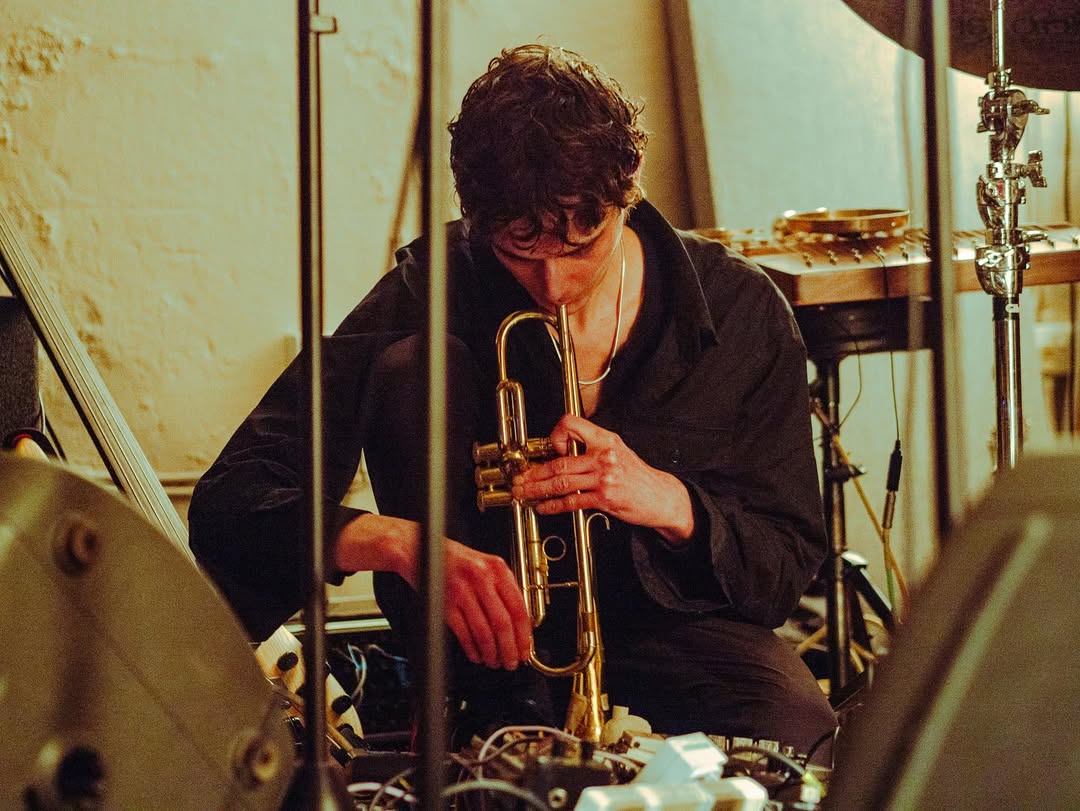
Hardwick-Allan’s music practice extends the same concern with transmission without stable reference. A true folk song is one that has lost its author: with A Shovel Dance Collective, one of the multiple bands he is part of, songs are treated as forms without fixed authorship – folk material that survives through repetition and variation rather than preservation. The collective reactivates dispersed repertoires, from prison abolitionist songs to doomed love songs spanning the last five centuries, as residual culture slipping through the cracks of dominant systems.
With Search Engine Quartet, compositions are commissioned as scores and interpreted by the four performers, producing chains of versions across different mediums. Traceable through these iterations yet never fully reducible, the songs are not covers but carriers of information and forms of communication that persist despite shifting contexts and power structures. In the cast iron reliefs as well, forms persist through variation rather than fixity.

What emerges in the work finds a productive articulation in Michel Serres’s logic around the Parasite, where every system depends on a certain amount of noise in order to function, even as that same noise threatens to overwhelm it. Noise here can be understood as the grain of a previous material, the trace of prior formations carried into new ones. In this sense, meaning is never carried intact. It is continuously reconfigured through friction, distortion, and re-entry into new contexts. “Images rise to the surface regardless,” Hardwick-Allan notes. “They are relentless, like meaning, but can always be broken down again to activate any latent chemical potential they might still contain.” The image operates less as representation than as a site of reactivation. The image is the parasite of the surface, or the surface the parasite of the image.
Within both matter and language, the work searches – in sculpture and in music – for what persists beyond origin, recalling Derrida’s spectral textuality. A form of hauntology of matter emerges here: the return or persistence of elements from social and cultural pasts, continuing to act within the present as if to haunt it.
The falcon’s gut
Falconers place greaseproof paper beneath a perch to catch a falcon’s first mute of the morning, reading its colour for signs of the day ahead. The practice turns on the mystery of a falcon’s gut: an interior space that remains inaccessible, known only through what it expels. Monitored in a similar way, Hardwick-Allan takes digestion as a model for how meaning operates.
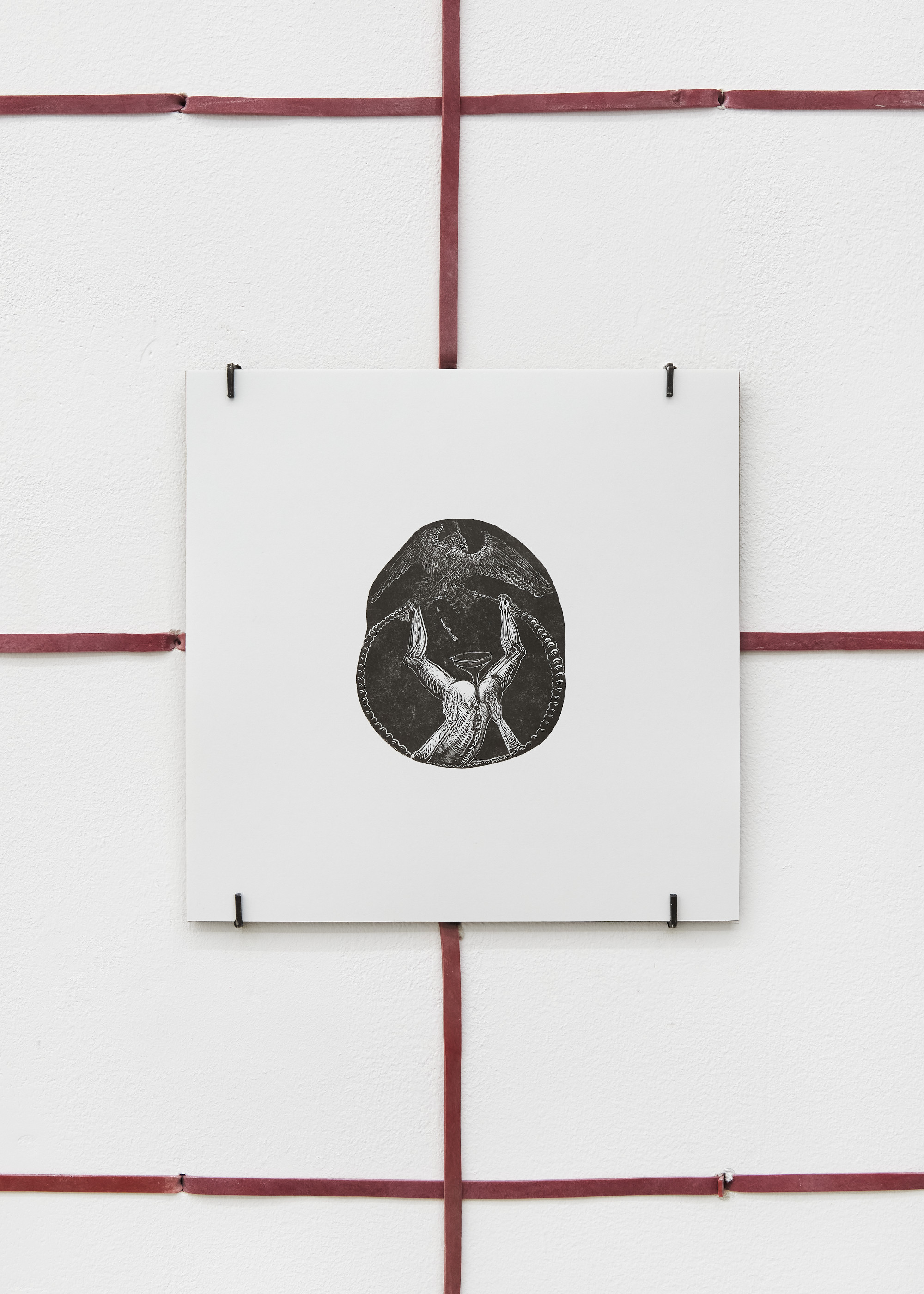
Exterior matter becomes interior, is absorbed and transformed, then returns to the world as residue. The hidden process can only be inferred from its trace. This logic runs throughout the work, where loss is not the opposite of production but its condition – an economy of expenditure that recalls Bataille’s solar logic, where energy is spent without return nor purpose.
Hardwick-Allan’s idea of “reverse alchemy” follows the same arc, shifting attention from ascent to descent, favoring dust over purity. “The act of making is one of loss,” he says.
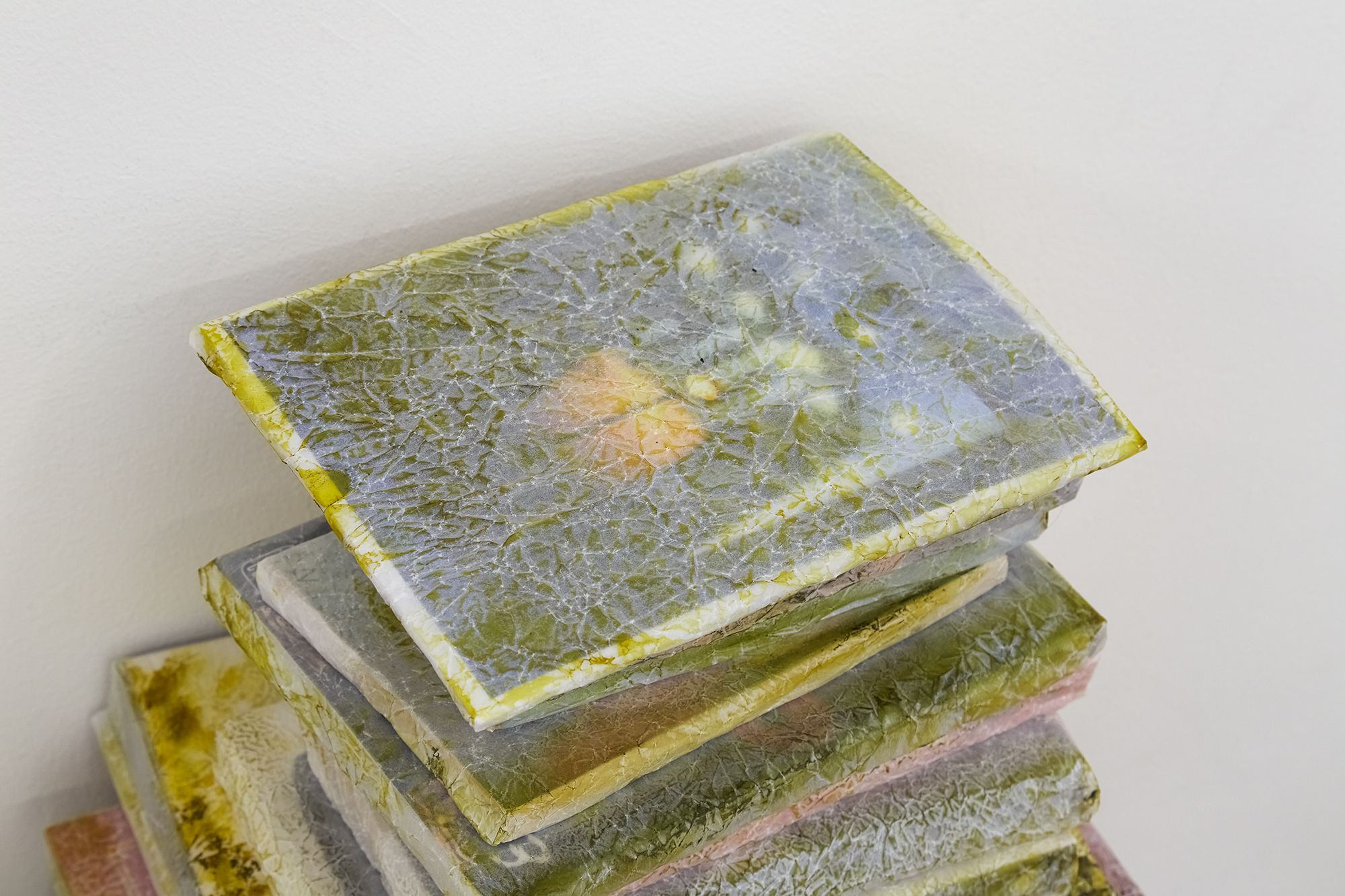
This lateral movement is also materialised in his zines. Using tracing paper, information can be read simultaneously across and through layers. Meaning proceeds metonymically, through interaction and adjacency – one element leading to another without resolution.
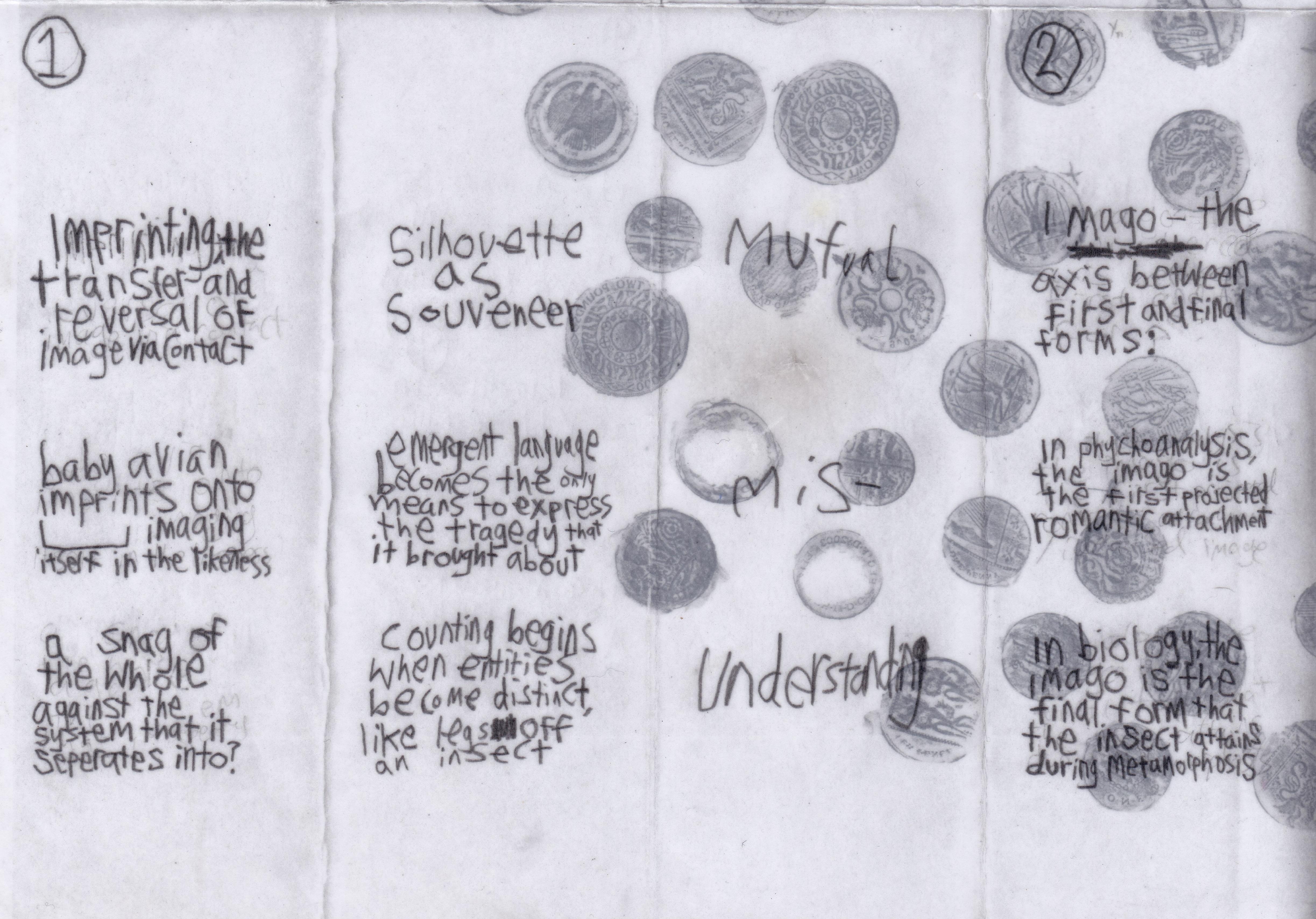
In Hardwick-Allan’s work, there is a playfulness without irony or almost; “Maybe that’s the clowning impulse,” he says – having attended clown school before art school – a lightness that refuses to fix itself in position, a practice of instability and circulation.
Unsealed iron rusts, eats itself, keeps recording its exposure with the air. The song is sung again, differently. The poor image recompresses and keeps circulating. Iron remembers the wood not despite its absence but because of it – the memory is the absence, given form.
J. A. Baker, The Peregrine (London: Collins, 1967).
Hito Steyerl, “In Defense of the Poor Image,” e-flux journal, no. 10 (November 2009), https://www.e-flux.com/journal/10/61362/in-defense-of-the-poor-image.
Raymond Williams, Marxism and Literature (Oxford: Oxford University Press, 1977).
Michel Serres, The Parasite, trans. Lawrence R. Schehr (Baltimore: Johns Hopkins University Press, 1982).
Jacques Derrida, Specters of Marx: The State of the Debt, the Work of Mourning, and the New International, trans. Peggy Kamuf (New York: Routledge, 1994).
Georges Bataille, “The Solar Anus,” in Visions of Excess: Selected Writings, 1927–1939, trans. Allan Stoekl (Minneapolis: University of Minnesota Press, 1985).
Georges Bataille, The Accursed Share: An Essay on General Economy, vol. 1, trans. Robert Hurley (New York: Zone Books, 1991).
July 1, 2026

