
Fatima Hellberg at MUMOK: The Conditions of Beginning
MUMOK’s new director Fatima Hellberg reconsiders the museum’s very function, with a clear inaugural gesture.
Every new museum director faces a question that is at once deceptively simple and fundamentally consequential: how do you inaugurate an institution without merely inaugurating its programme? A new cycle of exhibitions is rarely enough to redefine a museum. More often, a change in leadership announces itself through revised missions, new acquisitions, or shifts in institutional priorities. At Vienna’s MUMOK, however, Fatima Hellberg (Malmö, 1986) begins elsewhere. She does not proclaim a manifesto; instead, she sets in motion a different way of thinking the museum.
The two exhibitions opening Hellberg’s tenure initially appear to move in different directions. One unfolds through Tolia Astakhishvili‘s sprawling architectural intervention across two floors of the institution; the other takes Kate Millett‘s Terminal Piece (1972) as the point of departure for a far-reaching reconfiguration of MUMOK’s collection. Yet as visitors move between them, unexpected correspondences begin to emerge. Instead of functioning as separate chapters in the museum’s programme, the exhibitions gradually reveal themselves as two expressions of the same curatorial proposition.
What proves most striking is not simply the ambition of either exhibition, but the way each unsettles habits of looking that museums have long encouraged. Astakhishvili’s intervention dissolves familiar distinctions between architecture, artwork and display, while Terminal Piece disperses the collection across unexpected visual and conceptual constellations. Neither exhibition offers the reassuring coherence of a fixed narrative. Instead, both invite visitors to navigate uncertainty, assembling connections as they move through the galleries.
It is in this convergence that Hellberg’s inaugural gesture comes fully into focus. Perhaps it is no coincidence that such a curatorial proposition emerges in Vienna. Few museum cultures have understood the museum as an epistemic rather than merely custodial institution: a place where history is not simply preserved but reconfigured through changing regimes of vision, interpretation, and display. Hellberg’s inaugural programme does not break with that tradition; it reactivates it by shifting the museum’s authority from the stability of its holdings to the openness of the encounters they make possible. The two exhibitions establish a method: meaning does not precede the encounter but takes shape through it.
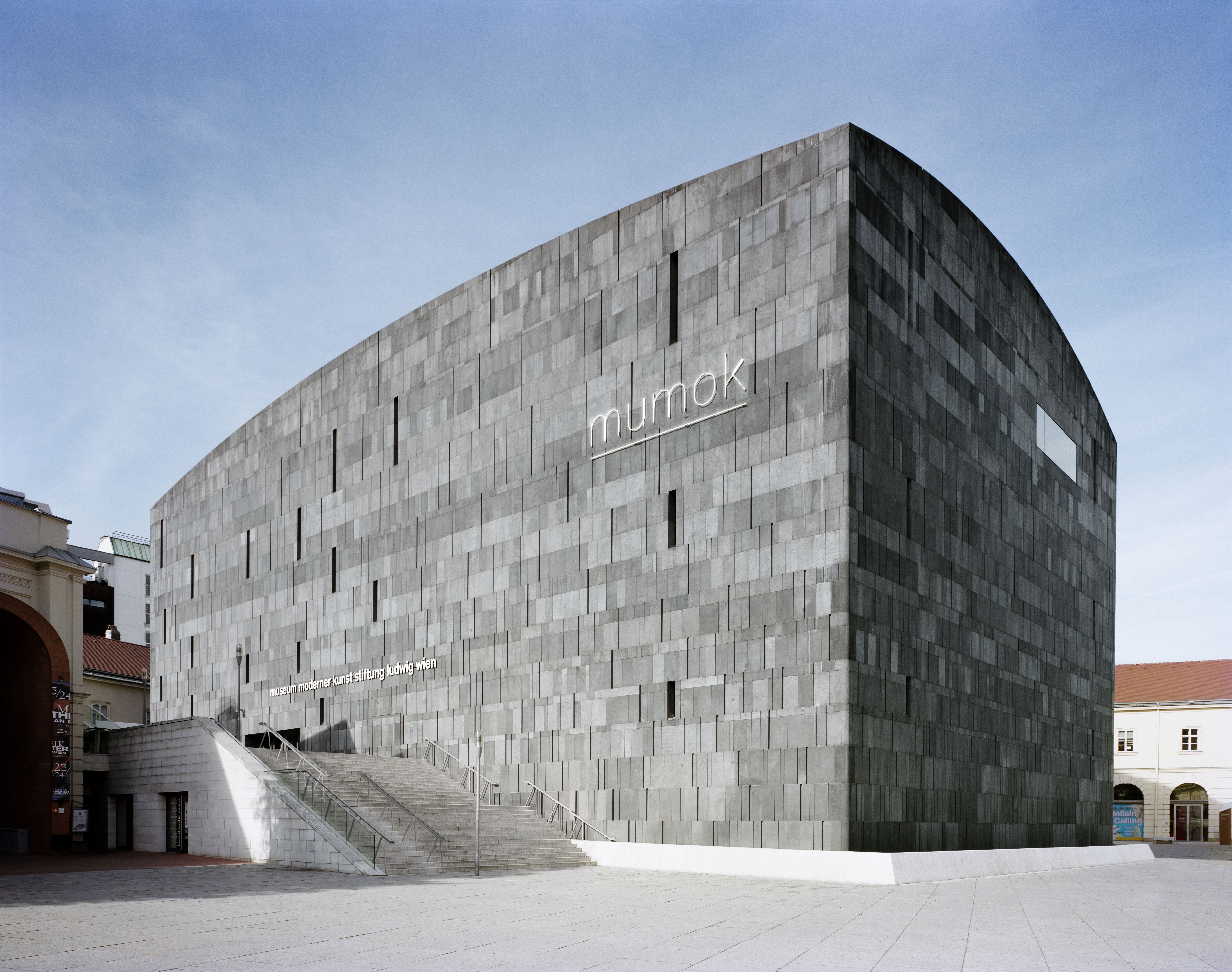
Both projects take shape from a condition of transition, albeit in different ways. In Figure of the Child, Astakhishvili approaches the child not as a biographical subject but as a condition of being in the world: one who enters it without yet possessing its codes, compelled to observe, adapt, and find orientation within a reality that precedes them. In Terminal Piece, by contrast, the threshold lies in the very act of looking. The installation, together with the exhibition unfolding around it, persistently questions the viewer’s position. Vision is no longer a contemplative act but an act of positioning.
If Figure of the Child redefines the conditions of encounter, it does so by intervening in the museum’s very fabric. Conceived across MUMOK’s two floors, Tolia Astakhishvili’s installation does not simply occupy the space: it alters its grammar. Walls, openings, cavities, architectural fragments, her own works alongside those of other artists, biographical traces, and works from the museum’s collection converge into a single environment where distinctions between building, artwork, and memory gradually dissolve.
Architecture has long been central to Astakhishvili’s practice, not as a backdrop but as a material that absorbs traces of habitation and transformation. At MUMOK, she works with the museum’s infrastructures, accumulated layers, and material history, interweaving works from the collection, loans, and site-specific interventions into an environment that feels at once familiar and unstable. The museum no longer simply hosts it; it is one of its primary materials.
The title itself signals this position. The child invoked by Astakhishvili is neither an iconographic subject nor an autobiographical figure, but a condition of arrival: one who enters an already constituted world without yet possessing its rules; who observes before understanding; who measures their body against languages, scales, and structures that precede them. As the curatorial statement suggests, this condition is defined by a tension between imaginative autonomy and dependence on the surrounding environment.
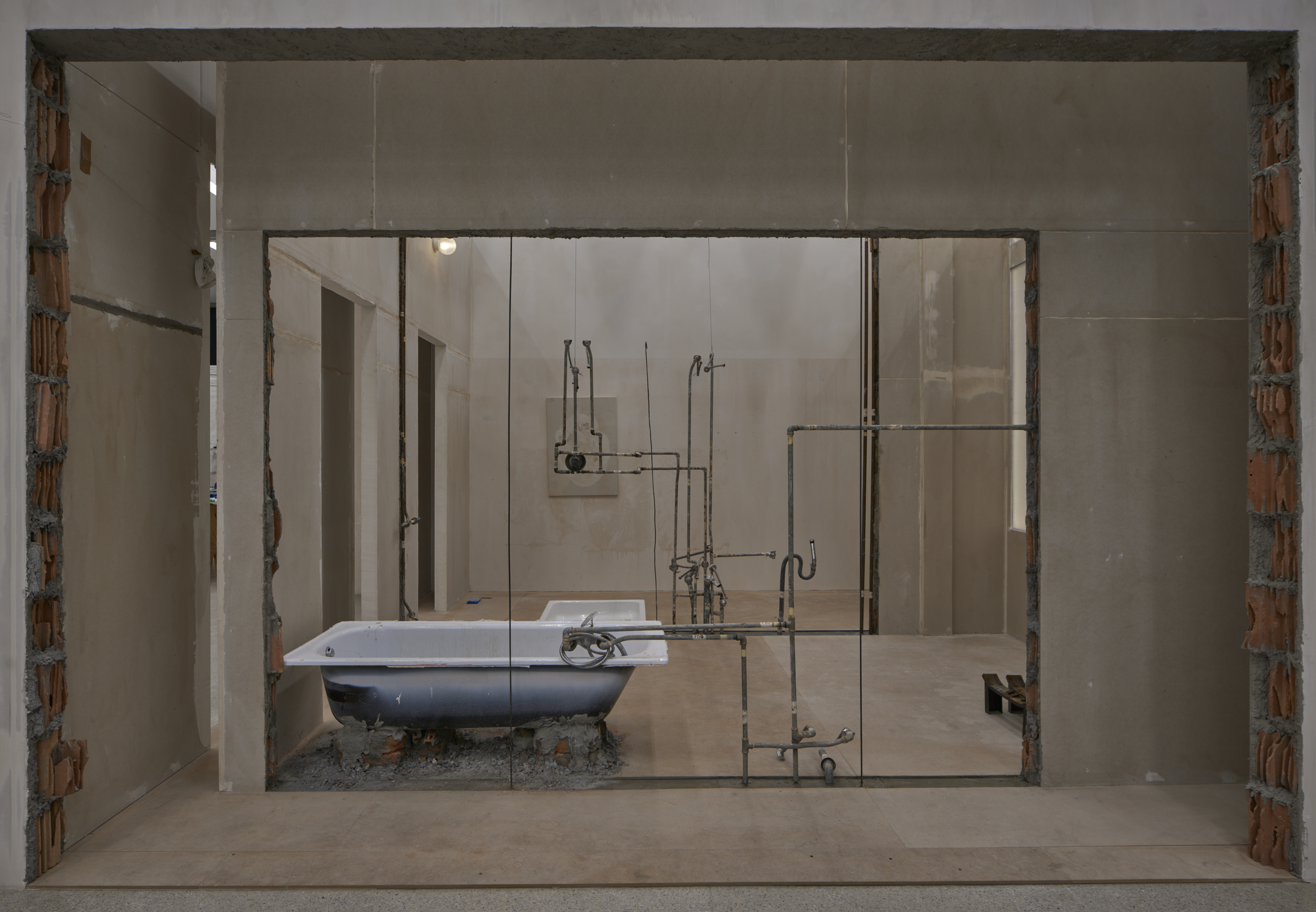
Here Hellberg’s curatorial project acquires its full resonance. In her catalogue essay, the child is neither a metaphor for innocence nor for growth, but a figure of original openness to the world: a subjectivity constituted through its relation to what precedes and exceeds it. Its conception recalls Henri Maldiney’s understanding of existence as that which is constituted by what comes to meet it, rather than by what is already known. Encounter does not confirm identity; it unsettles and reopens it.
This perspective also informed its development. In the months leading up to the opening, Astakhishvili made the installation process visible through Tolia Curriculum, inviting the public into stages of museum production that usually remain hidden. Workshops, readings, screenings, and collective events turned the exhibition’s preparation into part of the work itself.
More than opening the museum’s backstage, this decision reshapes the exhibition’s temporality. The work no longer coincides with its inauguration but extends across its own making, with its trials, revisions, relationships, and periods of waiting. It appears less as a finished object than as an ongoing process.
Within Vienna’s dense museum landscape, where collections have traditionally embodied continuity and historical authority, this opening signals a subtle but significant shift. Hellberg invites visitors not into a completed narrative, but into exhibitions that remain deliberately unfinished, unfolding through movement, attention, and encounter.
Astakhishvili’s attention extends to cavities, ducts, passageways, technical systems, and residual spaces: the infrastructures that allow the museum to function while ordinarily remaining out of sight. She does not excavate what is hidden; she brings these supporting structures into the field of perception. What usually recedes into the background enters the exhibition’s visual and spatial experience, making the museum newly visible. If Figure of the Child explores the conditions of entering the museum, Terminal Piece asks what happens once that space is inhabited. It opens with the acquisition of Kate Millett’s Terminal Piece (1972)—the first work to enter MUMOK’s collection under Hellberg’s directorship—and expands outward from this single installation to encompass nearly four hundred works, alongside loans and new commissions. The gesture is both economical and radical: rather than allowing the collection to legitimise the acquisition, one work serves as the catalyst through which the collection is reread.
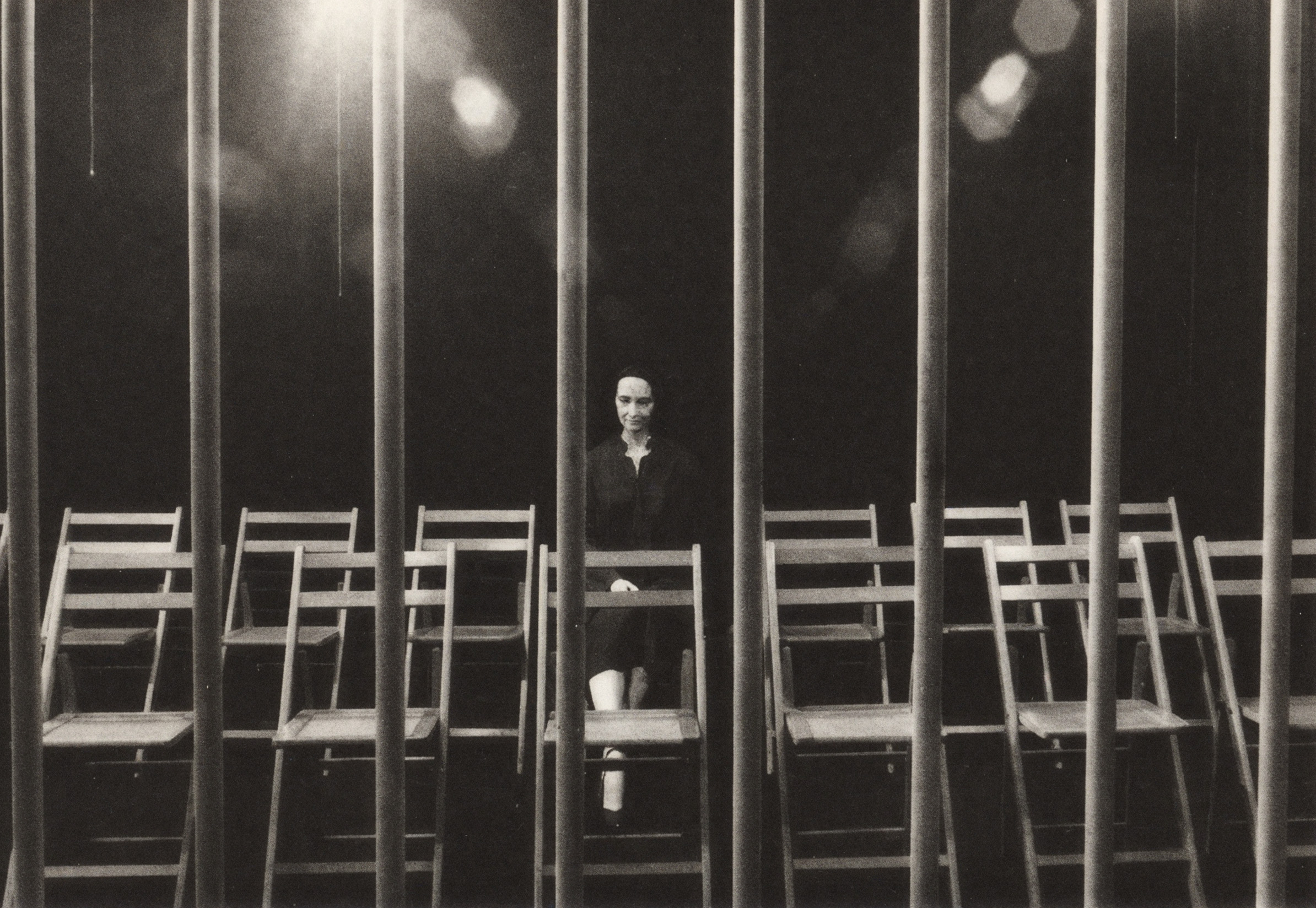
Its title contains this double movement. A terminal is not only an endpoint but also a place of departure, where every new journey carries the memory of previous ones. This ambiguity becomes its organising principle. Each work functions as a point of passage, altering the way the others are seen. As the gallery text suggests, the museum remains “open, alive, and changed by every encounter.”
Entrusting the inauguration of MUMOK’s new phase to this acquisition is more than a symbolic gesture; it establishes a curatorial method. As an artist, writer, and activist, Kate Millett understood the artwork as a site of direct engagement with lived experience, extending well beyond the conventions of contemplation. Hellberg reactivates that proposition, making Terminal Piece both the exhibition’s point of departure and the catalyst for a renewed reading of the collection. The questions posed at the entrance—Who is watching? Who is seen? Where do we position ourselves?—immediately unsettle the act of looking. Observation is no longer presented as neutral but as a position one inevitably occupies. Looking entails responsibility, entering into a relation that transforms both observer and observed. “To look is to participate”: the curators’ formulation succinctly captures the exhibition’s premise. From there, it unfolds across five acts. They abandon chronology and art-historical taxonomy in favour of different modes of seeing. Particularly striking is the prologue conceived by Anna Viebrock, which transforms the ground floor into a sequence of domestic interiors, corridors, thresholds, and shifting perspectives that quietly dissolve the neutrality of the white cube. Visitors find themselves moving through spaces that seem at once familiar and strangely theatrical, where the boundaries between exhibition architecture and lived environment become increasingly unstable. The works are not arranged according to categories but woven into a spatial dramaturgy in which the visitor’s own trajectory becomes one of the exhibition’s organising principles. Here the dialogue with Astakhishvili’s project becomes unmistakable. Although they proceed through different means, both exhibitions dismantle the conventions that ordinarily organise museum experience. In each, visitors are required to continually renegotiate their physical, perceptual, and cognitive orientation. It is here that the two exhibitions converge most fully. If Astakhishvili foregrounds spatial experience, Terminal Piece extends the same logic to the collection itself, treating it as something reconfigured through every new constellation. This perspective recalls Karen Barad’s account of meaning as emerging through intra-actions rather than residing in independently existing objects or subjects.
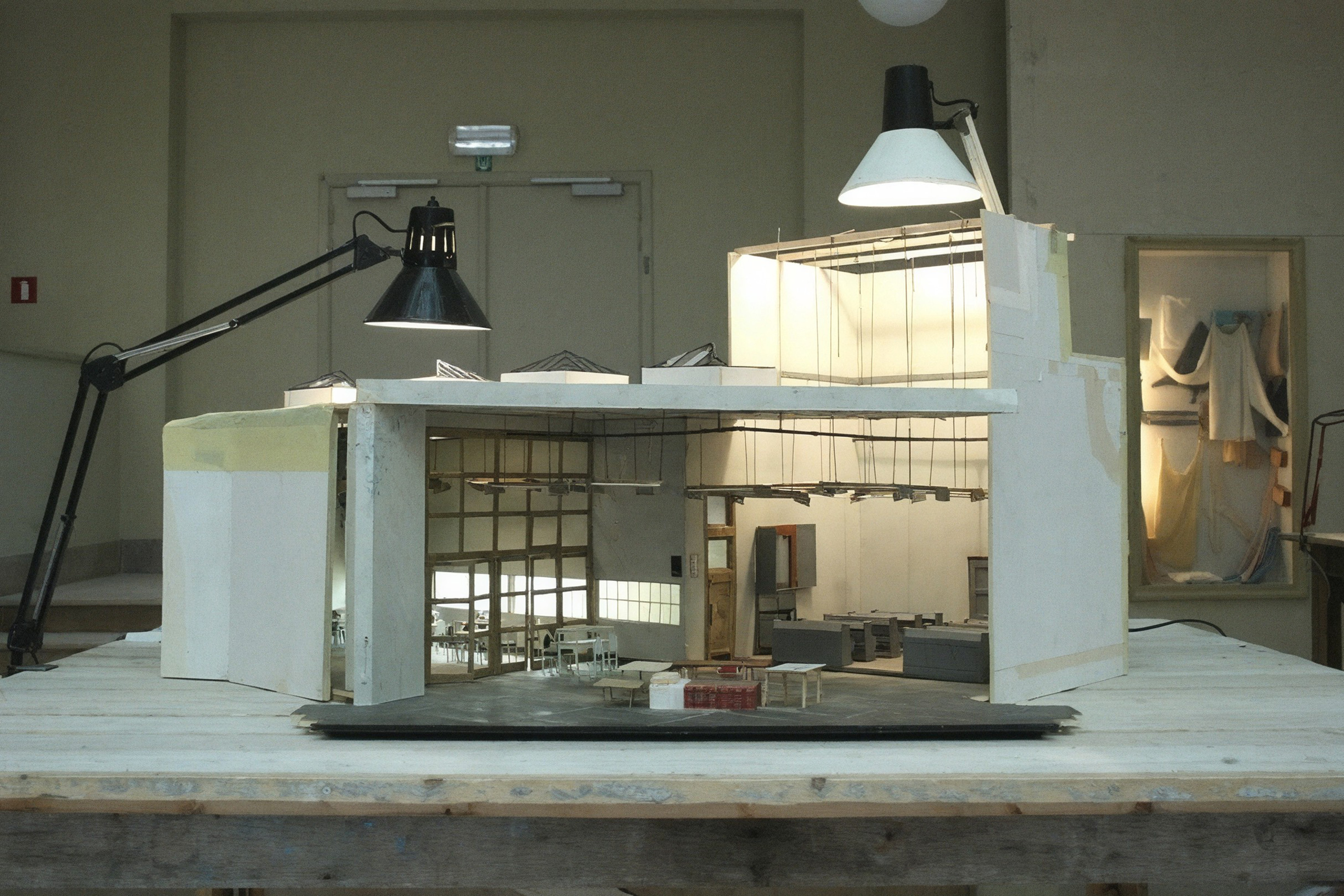
MUMOK’s new chapter takes shape through this dynamic understanding of the institution. Its authority no longer rests on preservation and classification alone; the museum is presented instead as a place where each acquisition, installation, and encounter has the capacity to reshape the collection’s significance.
Ultimately, the two inaugural exhibitions share the same conviction: that a museum is defined less by what it preserves than by the relationships it enables. Figure of the Child reveals space as an accumulation of traces and presences; Terminal Piece treats the collection as something reread through new constellations of works and viewers. It is no coincidence that Hellberg inaugurates her directorship without either a manifesto exhibition or an encyclopedic reinterpretation of the collection. Instead of asserting a new institutional identity, she establishes a curatorial method: one in which exhibitions remain open propositions, resisting definitive statements. From this perspective, the child invoked by Astakhishvili and the visitor addressed by Terminal Piece begin to converge. Both enter a world that cannot be grasped all at once. Both must learn to orient themselves without predetermined paths. Henri Maldiney would describe this condition as transpassibility: the capacity to be reached by what arrives before it can be absorbed into what one already knows.
This, perhaps, is what is ultimately at stake in MUMOK’s new phase. Not simply the redefinition of a museum’s programme, but a reconsideration of its very function. At a moment when many institutions oscillate between the celebration of cultural heritage and the demands of contemporary relevance, Hellberg points towards a third possibility. Perhaps this is what every beginning ultimately demands: not the certainty of a new direction, but the willingness to expose both institution and visitor to what cannot yet be known. If these first exhibitions achieve anything, it is not the announcement of a programme but the inauguration of that shared condition of uncertainty.
The conditions of beginning, then, extend beyond the inauguration of a new directorship. They describe the moment in which an institution chooses not to secure its authority, but to place it in question —trusting that a museum remains most vital when it remains open to new encounters, new readings, and the possibility of being changed.
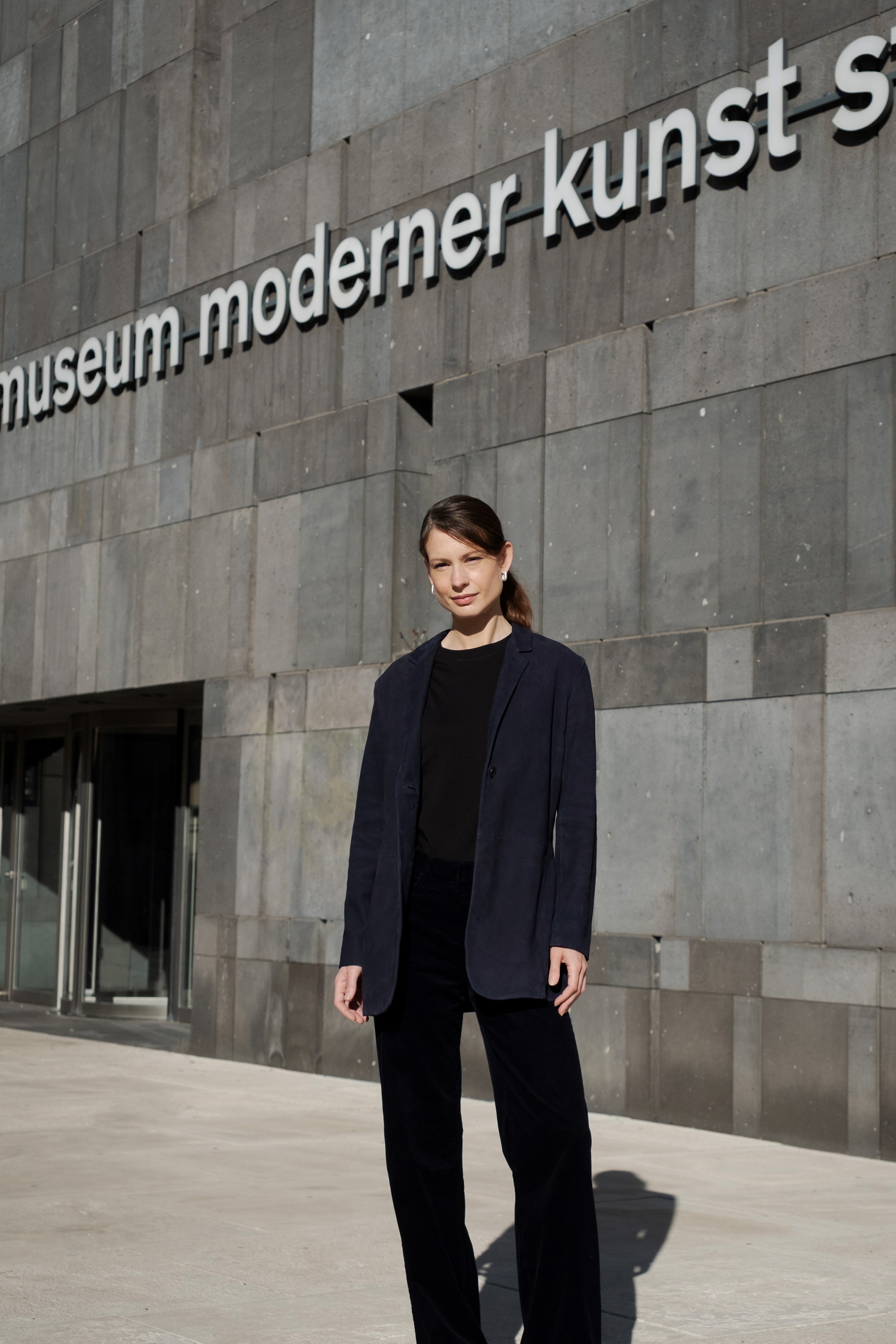
Museums have traditionally been organised around objects. Your inaugural programme seems to shift the emphasis towards conditions, relations and encounters. Do you think the museum is moving away from an ontology of objects towards an ecology of situations? And if so, what does this transformation demand of a curator?
Fatima Hellberg: I am very interested in the question of where an exhibition starts—where does the threshold of one form of looking shift into another? How and when do we become “viewers”? It does not happen automatically. Instead, there is a grammar of how attention is established, shifted and held. Art has this remarkable quality of being both epic and mundane, and this requires space for the viewer. To offer that space means that a museum has to be willing to embark on projects to which it does not yet hold all the answers. Within the encounter lies the potential of transformation, between the objects and the viewer, and in that third space which emerges between them. What an object-oriented and relational approach demands from the curator is a close exchange with the artist and the work, a curiosity about the experience of the viewer, and the larger container framing the situation.
Both Figure of the Child and Terminal Piece resist the idea of the exhibition as a finished statement. They seem to unfold in different temporalities—construction, memory, repetition, anticipation. Can an exhibition become a way of thinking about time rather than a way of presenting works?
Fatima Hellberg: Exhibitions hold the potential to operate with an interior logic, one connected with the world outside, which also has the agency of introducing its own sense of truth. The writer Rachel Cusk, who wrote a beautiful essay on Terminal Piece spoke of truth as the simple moment when a reader feels that what is written strikes a chord of knowing—it might be surreal, but we recognize it. I like a show to be true to itself and to the vision of the artist. There is this beautiful moment of realizing an exhibition when the show also starts letting itself be known—it’s an invisible engine. I think this is where a more intimate vibration between art and life happens, and these are the moments when a show can also become profoundly perceptive and revealing about its time.
Museums have long been institutions that organise knowledge. Yet your programme seems to suggest that knowledge is something produced through uncertainty rather than certainty. How do you imagine the relationship between knowledge and not-knowing within the museum today?
Fatima Hellberg: Artworks do hold a certain suspended quality, they are many-sided-objects, and depending on context, perspective and methodology, there needs to be space for new ways of seeing. This does not mean that everything is up for grabs and that we are in a continuous state of uprooting. There is knowledge, and the role of the museum is to be a public service committed to scholarship and mediation. But equally, the awareness of the apparatus of that knowledge, and an active turning of the many-sided-object is also part of it. The poet and writer Fanny Howe has written about doubt, and the great effort involved with keeping more than one reality possible. Yet, I think this is what is demanded of us, and I think visitors can handle it—life is complicated, and art is intimately connected with it.
Contemporary museums increasingly speak about participation, inclusion and care. Your exhibitions, however, seem less interested in producing consensus than in exposing visitors to forms of instability. Should museums today be spaces of reassurance—or spaces where our relationship with reality becomes more complex?
Fatima Hellberg: I think we need both, we need the possibility for affirmation and critique. With my understanding of curatorial work as one which needs to be situated, the legacy of institutional critique plays a key role. We can however not afford to exercise it in the same way—in times when the value of public art institutions is being challenged, deconstruction means something different. Same goes for more relational approaches: they also require an awareness of the modes in which the relational so readily becomes instrumentalised. I think we are in urgent need of both reassurance and a belief in institutions, and a certain boldness in that coupling. In the end, not taking a risk is a very great risk.
If modern museums were largely built around the idea of history, what should contemporary museums be built around today? Presence? Experience? Conflict? Imagination? Or do we need an entirely different vocabulary?
Fatima Hellberg: I like to think of ideas which imply a level of process and method. This is how we worked with Terminal Piece: it is an exhibition, but it is also an approach which sets the tone for a way of working. In the commitment to the close reading, the focus shifts not merely to what the artwork is, but what it does.
For me, the museum we are working towards needs to be rooted, specific and then traveling. What I mean by this is that it needs to be rooted in its conditions—it can not be indifferent to its physical or structural being, nor to its local context and the dynamics and atmospheres specific to it. The museum is shaped by the place and the people working in it. That next consideration, the specificity has to do with attending with intentionality and precision to the artworks, to the artists, the content and to the possibilities associated with its mediation. The final consideration, that of traveling, speaks to me of the potential of taking off… The possibility of transformation, and the quality of aliveness. This change might mean a shift in the perspective of the viewer, but also more fundamentally, of the museum being part of a change—of introducing new ideas and connections, and of trusting new directions.
July 23, 2026

